Wi-Fi 7 and Beyond: The Cat6A Shielded Requirement
Discover why Wi-Fi 7 demands Cat6A shielded cabling to handle 10Gbps speeds and high-power PoE, ensuring your commercial network is future-proof.
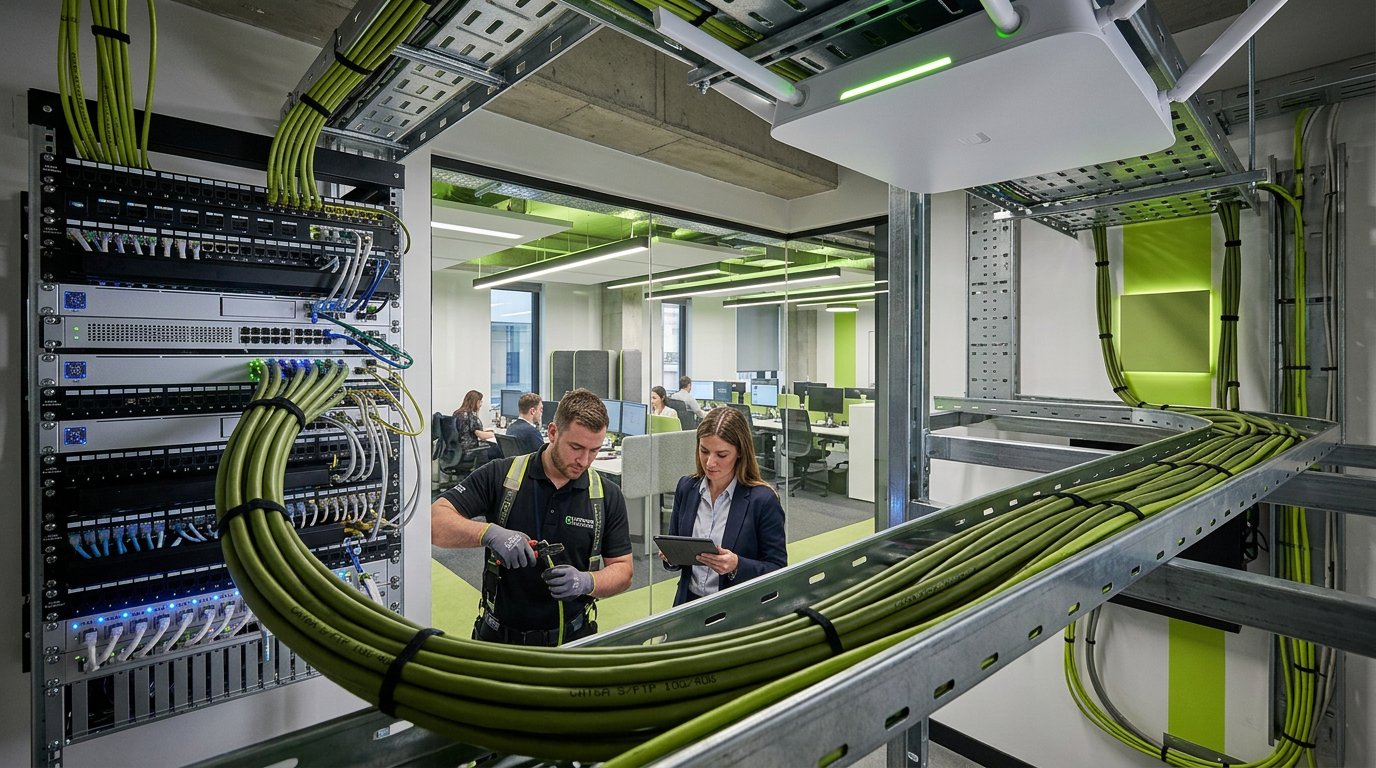
When your team complains about a "slow network," they usually blame the wireless signal. However, in the era of Wi-Fi 7, the bottleneck is rarely the airwaves—it is the copper hidden behind your ceiling tiles. As enterprise environments shift toward ultra-high-speed wireless, the infrastructure supporting those Access Points (APs) has become the most critical variable in the building.
Recent market data indicates that Cat6A has officially become the new commercial baseline, capturing the high-performance share of a structured cabling market projected to reach over $30 billion by the early 2030s. If you are planning a wireless refresh, sticking with legacy Cat6 or unshielded cabling isn't just a missed opportunity; it’s a technical liability.
The Wi-Fi 7 Performance Leap
Wi-Fi 7 (802.11be) introduces Extremely High Throughput (EHT), offering peak rates that can exceed 30 Gbps. While real-world commercial speeds are lower, they easily surpass the 1 Gbps limit of standard Cat6 cabling.
To unlock the potential of Wi-Fi 7, your network backbone must support Multi-Gigabit Ethernet (2.5G, 5G, or 10G). Cat6A is the only twisted-pair copper standard that guarantees 10 Gbps performance over a full 100-meter run. Without it, your expensive new Wi-Fi 7 APs will be throttled by a 1 Gbps "straw" at the wall jack.
Why "Shielded" is No Longer Optional
While standard Cat6A provides the speed, Shielded Cat6A (F/UTP or S/FTP) provides the reliability required by modern building codes and hardware demands. The industry is seeing two major shifts that make shielding a necessity:
- Alien Crosstalk (AXT): Wi-Fi 7 operates at higher frequencies. When multiple high-speed cables are bundled together in a tray, the signals bleed into one another. Shielded cabling virtually eliminates this interference, ensuring that your 10G connection doesn't drop to 1G due to noise.
- Heat Dissipation and PoE++: Modern APs are power-hungry. Wi-Fi 7 radios often require PoE++ (Type 3 or Type 4), delivering up to 60W or 90W of power. High-power PoE generates heat within cable bundles. Shielded cables act as a heat sink, dissipating thermal energy more effectively than unshielded alternatives, preventing the cable degradation that leads to packet loss.
Grounding the Shift: Standards and Compliance
This isn't just a recommendation from hardware manufacturers; it is reflected in evolving standards. The TIA-162-A (Telecommunications Infrastructure Standard for Wireless Access Points) specifically recommends Cat6A for all new wireless installations to accommodate the increasing throughput requirements.
Furthermore, as industrial facilities collapse their IT and Operational Technology (OT) into unified lanes—a trend accelerated by the upcoming IEC/IEEE 60802 TSN profile—the need for electromagnetically shielded infrastructure becomes paramount. In environments with heavy machinery or digital signage interference, unshielded cable is a recipe for intermittent downtime.
Practical Steps for Facility Managers
If you are overseeing a retail chain, a healthcare campus, or a corporate office, here is how to approach your next wireless deployment:
- Audit Your Existing Runs: Do not assume your Cat6 can "handle it." While it might sync at 5G over short distances, it won't provide the long-term stability needed for a 10-year infrastructure lifecycle.
- Verify Certification: Industry statistics show a significant portion of new cabling fails certification on the first attempt. Ensure your integrator provides Fluke test results specifically showing 10G compliance and shield integrity.
- Plan for Density: Wi-Fi 7 thrives on 6GHz bands, which have shorter range than 2.4GHz. You will likely need *more* APs, not fewer. Designing your cabling grid for higher density now prevents costly retrofits in 24 months.
The Bottom Line
Structured cabling is the nervous system of your business. As AI-driven network monitoring and high-density wireless become standard, the quality of your physical layer determines your operational uptime. Upgrading to Cat6A shielded cabling isn't just about speed—it's about building a foundation that can handle the thermal, electrical, and data demands of the next decade.
Sources
- [Structured Cabling Market, Share | Analysis Report 2035](https://www.marketresearchfuture.com/reports/structured-cabling-market-2266)
- [Structured Cabling Market Size By Type, By Product, ...](https://www.linkedin.com/pulse/structured-cabling-market-size-type-product-global-industry-4woaf)
- [Cable Management Market Size, Industry Share](https://www.fortunebusinessinsights.com/cable-management-market-105628)
InCTRL Technology Team
Commercial integration specialists with 20+ years installing security, cabling, signage, AV and IT systems across Central Florida. About us
Explore our services
Areas we serve
Need This Done at Your Facility?
Orlando-based since 2004 — 3,300+ jobs completed. Talk to a real technician, not a call center.