Wi-Fi 6E for Florida Schools: Why the 6GHz Band Matters Now
Why Wi-Fi 6E and the 6GHz band help Central Florida schools handle dense classroom device loads, and what cabling and access points it requires.
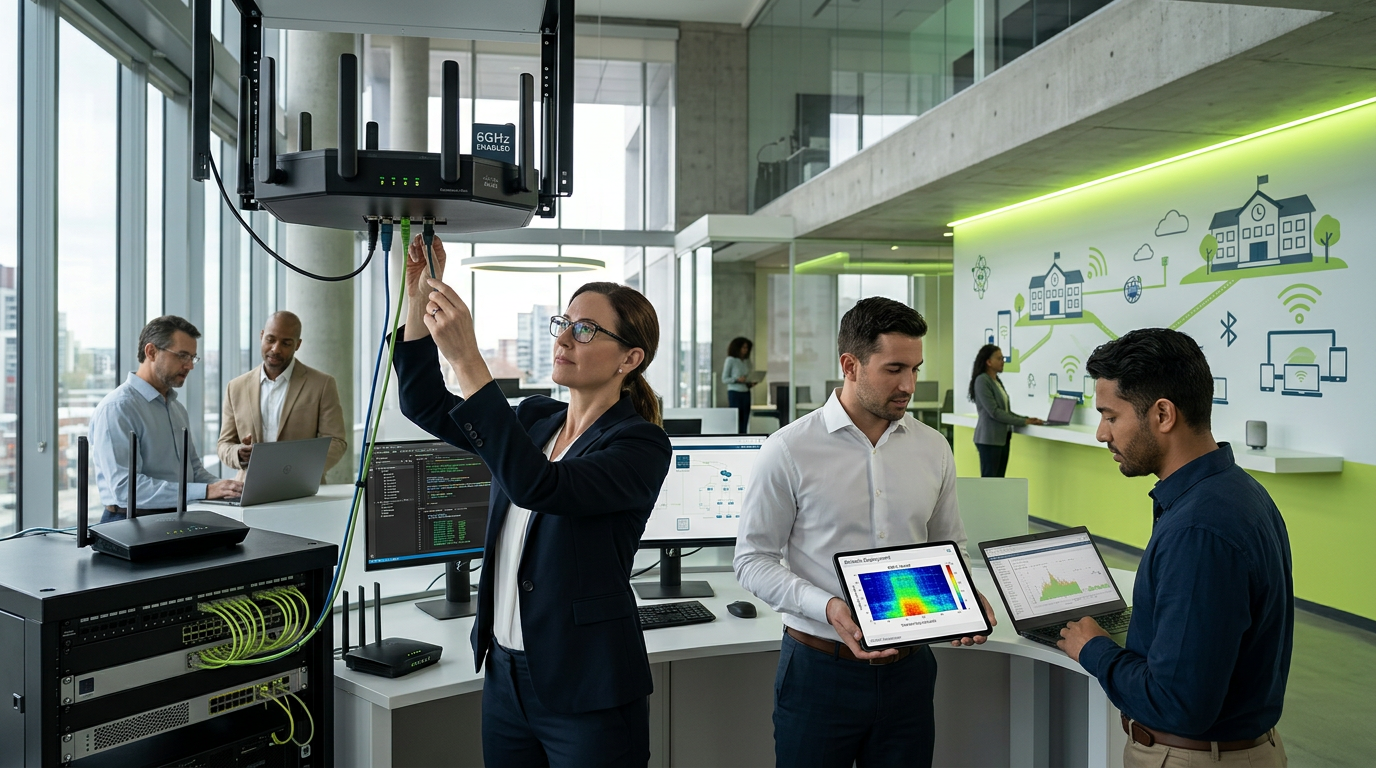
Wi-Fi 6E matters for Florida schools because it adds the 6GHz band — 1,200 MHz of clean spectrum the FCC opened in 2020 — giving classrooms far more channels and far less interference than crowded 2.4GHz and 5GHz networks. That means more devices streaming and testing at once. To get the benefit, schools need 6E access points, WPA3 security and cabling (typically Cat6A) that supports multi-gigabit uplinks and higher-power PoE.
Quick Facts
- New spectrum: 6GHz adds up to 59 20MHz channels or 7 160MHz channels.
- Security: WPA3 is required on 6GHz.
- Range: 6GHz travels shorter distances, so access points are placed more densely.
- Cabling: Cat6A supports multi-gig uplinks and PoE for newer access points.
Imagine a high school media center where three hundred students open their laptops simultaneously to stream high-definition educational content. In the past, this scenario was a recipe for signal degradation, latency, and frustrated educators. Today, the introduction of the 6GHz band via Wi-Fi 6E isn’t just an upgrade—it’s becoming the baseline for modern educational infrastructure.
For Central Florida school districts, from Orange to Polk County, the shift toward Wi-Fi 6E is being driven by more than just a desire for faster downloads. It is being propelled by a critical update in industry standards and the sheer density of devices in the modern classroom.
The Move to the 6GHz Spectrum
Until recently, Wi-Fi operated exclusively on two bands: 2.4GHz and 5GHz. As every classroom began utilizing 1-to-1 device programs, these frequencies became overcrowded. Think of it like a four-lane highway during rush hour on I-4; no matter how fast the cars are, the sheer volume of traffic causes a standstill.
Wi-Fi 6E changes this by opening up the 6GHz band. This adds up to 1,200 MHz of new spectrum. Unlike the older bands, the 6GHz space is exclusive to Wi-Fi 6E-compliant devices. This means no interference from legacy hardware, microwave ovens, or older Bluetooth sensors. For a school, this translates to "clean" airwaves dedicated to high-bandwidth learning tools.
Compliance and the TIA 2026 Shift
One of the most significant drivers for this transition is the recent focus from the Telecommunications Industry Association (TIA) regarding structured cabling standards for 2026. Industry leaders are emphasizing that infrastructure is no longer just about "making it work"—it is about validation and long-term compliance.
As standard-setting bodies like BICSI and TIA update their frameworks, there is a clear shift toward supporting higher power densities and thermal loads. This is particularly relevant for schools deploying Wi-Fi 6E access points (APs), which often require:
- PoE++ (802.3bt): Many 6E access points require more power than traditional PoE+ can provide.
- Category 6A Cabling: To truly leverage the multi-gigabit speeds of 6GHz, 10Gbps-capable copper cabling (Cat 6A) is now the required standard for new installations.
- Fiber Backbones: With increased edge speeds, the backbone connecting IDF closets to the MDF must be upgraded to 10G or 40G fiber to prevent bottlenecks.
Enhancing Campus Security and Physical Safety
In Central Florida, campus security is a top priority. Wi-Fi 6E doesn't just help with homework; it stabilizes the mission-critical security systems that InCTRL Technology Services integrates daily.
- High-Definition Surveillance: Modern IP cameras require consistent bandwidth to ensure clear facial recognition and zero dropped frames. Especially in expansive outdoor areas or sports complexes, a robust wireless mesh using 6GHz can bridge gaps where trenching cable is cost-prohibitive.
- Access Control Integration: Smart locks and IoT sensors rely on low-latency connections. By offloading student traffic to the 6GHz band, these security devices can operate on the 2.4GHz or 5GHz bands with significantly less interference.
- Emergency Communication: During a lockdown or emergency event, cellular networks often become congested. A robust, managed Wi-Fi network ensures that staff can maintain communication through VoIP and emergency notification apps without delay.
The Role of Structured Cabling and Validation
As highlighted in recent industry discussions, "Infrastructure is breaking down in the field" when installation isn't handled with precision. It isn't enough to simply buy 6E-capable routers. If the underlying Structured Cabling isn't validated, the network will suffer from packet loss and intermittent connectivity.
For school districts, this means moving away from "good enough" installations. Validation testing—using specialized tools to certify that every drop meets TIA-568 standards—is the only way to ensure the 6GHz revolution actually delivers on its promise. This includes checking for alien crosstalk, which is much more prevalent in high-density school environments.
Digital Signage and Modern Pedagogy
Beyond the laptop, Wi-Fi 6E is transforming the physical look of schools. Digital Signage and interactive displays in hallways and cafeterias are now being used for real-time announcements, wayfinding, and even emergency alerts. These displays often stream high-resolution video content that, on older Wi-Fi standards, would stutter or buffer. With the 6GHz band, these systems can run flawlessly, providing a professional and tech-forward environment for students and visitors alike.
Preparing for the Future
School districts shouldn't view Wi-Fi 6E as a luxury. With the 2026 TIA updates on the horizon and the increasing demand for AI-driven educational tools, the 6GHz band is a strategic necessity.
At InCTRL Technology Services, we specialize in the heavy lifting required to make these transitions seamless—from the fiber optic backbone in the server room to the Category 6A drops in the ceiling. If your facility or district is still operating on 5GHz alone, it’s time to look at the infrastructure that will support the next decade of learning.
Sources
- [Webinar: LAN Standards, News & Trends: 2026 Update - TIA Online](https://tiaonline.org/event/webinar-lan-standards-news-trends-2026-update/)
- [BICSI on Instagram: "Infrastructure is breaking down in the field. As ...](https://www.instagram.com/p/DXzIBbLIJ4T/)
- [Fiber Cable Plant - Let's Talk Cabling Podcast](https://letstalkcabling.com/category/optical-fiber/)
Frequently Asked Questions
Do older devices work on Wi-Fi 6E?
Older devices keep using 2.4GHz and 5GHz. Only 6E-capable devices use the 6GHz band, which frees the older bands for everyone else.
Does Wi-Fi 6E need new cabling?
Often. Many 6E access points use multi-gigabit uplinks and higher-power PoE, which Cat6A handles best.
Is Wi-Fi 6E worth it compared to Wi-Fi 7?
Wi-Fi 7 also uses 6GHz. Planning Cat6A cabling and 6GHz-capable access point locations now supports both.
Who installs school Wi-Fi and cabling in Central Florida?
InCTRL Technology Services installs structured cabling and wireless infrastructure for schools and businesses across Central Florida. See [structured cabling](/services/structured-cabling) or [contact us](/contact).
InCTRL Technology Team
Commercial integration specialists with 20+ years installing security, cabling, signage, AV and IT systems across Central Florida. About us
Explore our services
Areas we serve
Need This Done at Your Facility?
Orlando-based since 2004 — 3,300+ jobs completed. Talk to a real technician, not a call center.