Anatomy of a Modern Workspace: A Structured Cabling Case Study
Discover how a comprehensive Cat6A cabling infrastructure and MDF design transformed a new corporate office into a high-performance digital hub.
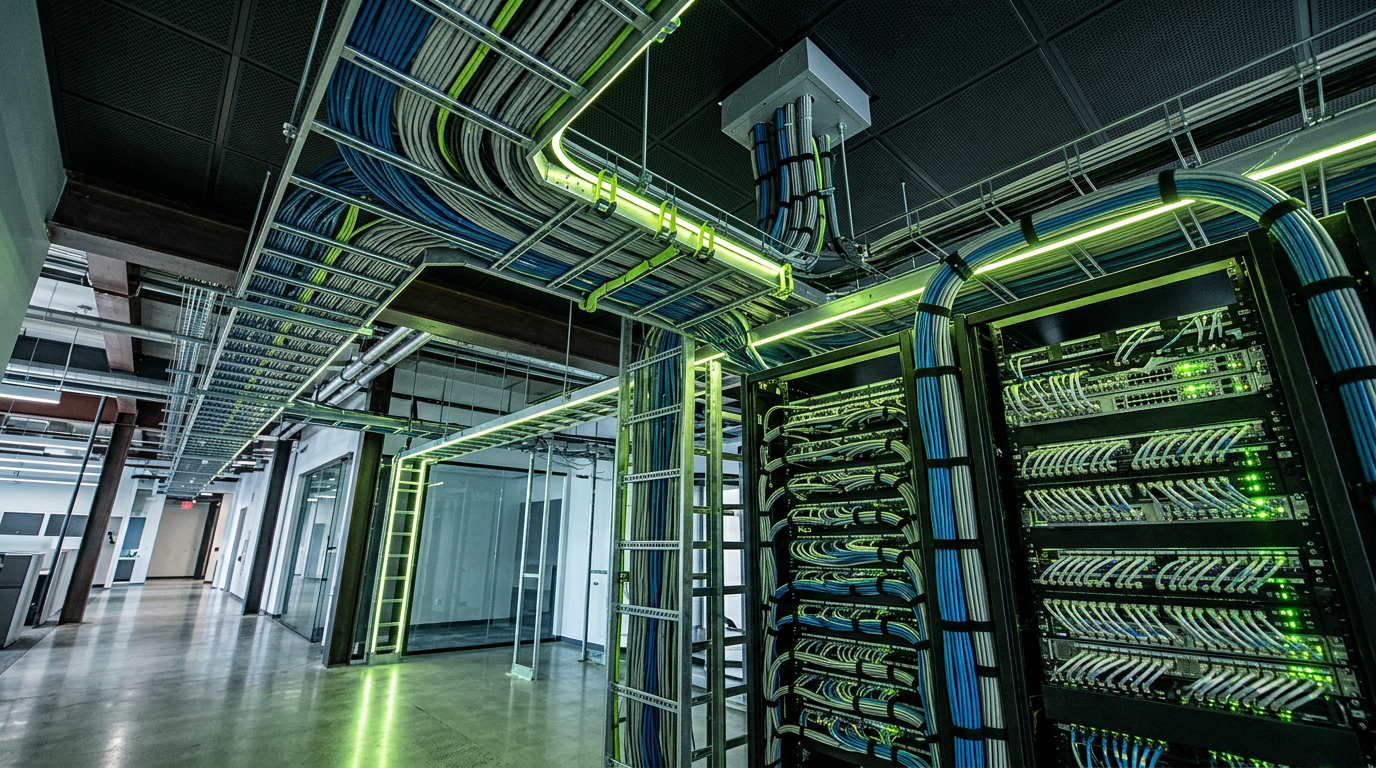
Designing a new corporate headquarters is often focused on architecture and interior design. However, the true heartbeat of any modern office lies behind the walls and above the ceiling tiles.
Recently, InCTRL Technology Services partnered with a growing corporate client to execute a complete ground-up structured cabling build-out. This project serves as a roadmap for how a properly planned infrastructure supports everything from high-speed data to physical security and collaborative AV systems.
The Challenge: Future-Proofing for Growth
The client required a scalable network capable of supporting 150+ workstations, a secure server room (MDF), multiple conference rooms, and a comprehensive security footprint. The primary challenge was ensuring the infrastructure could handle today’s high-bandwidth demands while remaining flexible enough for future technological shifts.
Without a robust cabling foundation, even the most expensive hardware will underperform. Our goal was to eliminate bottlenecks before the first employee ever logged in.
Phase 1: Designing the MDF and IDF Strategy
The project began in the Main Distribution Frame (MDF). This is the central nervous system of the building. For this project, we focused on three pillars: airflow, accessibility, and organization.
- Rack Integration: We installed four-post open-frame racks to house servers, switches, and patch panels.
- Vertical & Horizontal Cable Management: To prevent the "spaghetti" mess often seen in older server rooms, we utilized high-density managers to ensure every cable followed a dedicated path.
- Climate & Power: Coordination with HVAC and electrical teams ensured the room remained at optimal operating temperatures with dedicated power circuits.
Phase 2: The Vertical and Horizontal Backbone
For the horizontal cabling—the runs connecting the MDF to individual workstations—we selected Cat6A (Augmented Category 6) cabling.
While Cat6 is common, Cat6A was the right choice here for several reasons:
- 10-Gigabit Performance: It supports 10GBASE-T up to 100 meters, providing a massive runway for data-heavy applications.
- Reduced Crosstalk: Superior shielding reduces electromagnetic interference, which is critical in dense office environments.
- PoE+ Capabilities: The thicker gauge of Cat6A is better at dissipating heat generated by High-Power over Ethernet (PoE) devices like advanced Wi-Fi 6 access points and PTZ security cameras.
Phase 3: Integrating AV and Security
A modern office is more than just internet-connected desks. Our team integrated the cabling to support several sub-systems:
Digital Signage & AV
In the lobby and breakrooms, we ran dedicated lines for digital signage players. In the conference rooms, we installed shielded cabling to support 4K video distribution and integrated table-top connectivity, ensuring that "plug and play" actually works for the end-user.
IP Surveillance & Access Control
Security is a priority for any corporate entity. We deployed high-definition IP cameras at all entry points and throughout the common areas. These cameras, along with the electronic badge readers at the doors, all home-run back to the MDF, allowing the client to manage their physical security via a centralized software platform.
Phase 4: Testing, Labeling, and Certification
The most critical—and often overlooked—step in structured cabling is the final certification. A cable might pass a basic "continuity test" but fail to carry data at its rated speed due to a kink in the wire or poor termination.
InCTRL technicians utilized Fluke Level III testers to certify every single drop. We provided the client with a comprehensive report showing:
- Wiremap: Ensuring all pairs are connected correctly.
- Signal-to-Noise Ratio: Confirming the integrity of the data stream.
- As-Built Documentation: A detailed map and spreadsheet showing exactly which wall jack connects to which port in the server room.
The Result: A Ready-to-Work Environment
When the client’s IT team arrived to install their active equipment (switches and firewalls), the transition was seamless. Because the infrastructure was labeled, tested, and organized, the network was live in hours rather than days.
By investing in a professional structured cabling build-out, this corporate office is now equipped with a 10-to-15-year technology foundation. Whether they decide to upgrade to Wi-Fi 7, expand their video conferencing capabilities, or double their staff, the backbone of their business is ready to handle the load.
Building Your Infrastructure
If you are planning a move or a new construction project in Central Florida, don’t leave your technology to chance. Structured cabling is the one part of your office you don't want to fix after the drywall is up. Focus on quality, adhere to TIA/EIA standards, and always plan for the bandwidth of tomorrow.
InCTRL Technology Team
Commercial integration specialists with 20+ years installing security, cabling, signage, AV and IT systems across Central Florida. About us
Explore our services
Areas we serve
Need This Done at Your Facility?
Orlando-based since 2004 — 3,300+ jobs completed. Talk to a real technician, not a call center.