Single-Mode vs. Multi-Mode: Choosing the Right Fiber for Your Orlando Business
Discover the differences between Single-Mode and Multi-Mode fiber to ensure your commercial network is ready for 2026 connectivity standards.
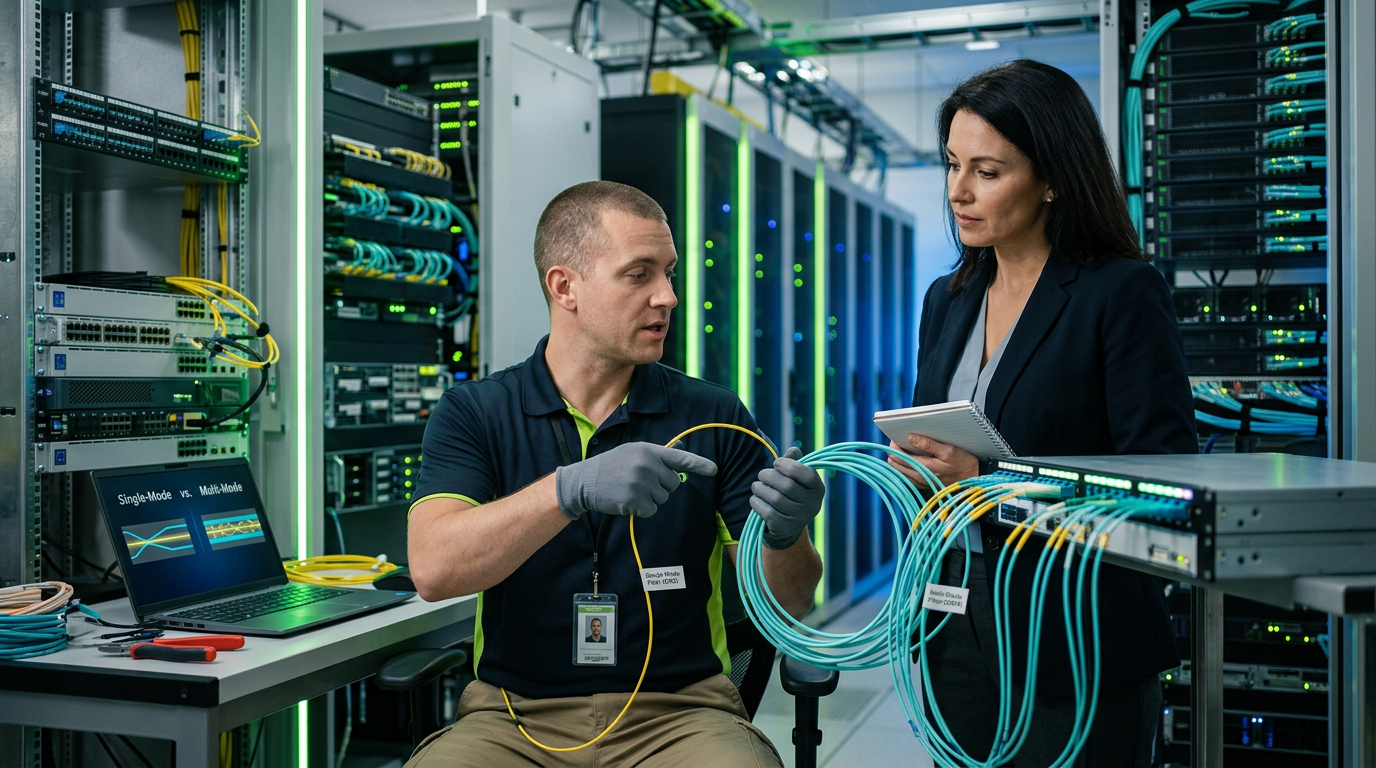
As Orlando prepares to host Fiber Connect 2026, the spotlight on high-speed infrastructure has never been brighter. For local businesses—from sprawling resorts on International Drive to massive distribution centers in Lakeland—the question is no longer *if* you should upgrade to fiber, but *which* type of glass will carry your data for the next decade.
With 2026 projections showing that fiber-optic connections are now the undisputed standard for symmetrical gigabit speeds, choosing between Single-Mode and Multi-Mode fiber is a critical decision that impacts your long-term scalability and bottom line.
The Core Difference: How Light Travels
At its simplest, the difference lies in the diameter of the fiber core.
- Single-Mode Fiber (SMF): Features a tiny core (typically 9 microns). It allows light to travel in a single path, or "mode," which virtually eliminates light reflection and signal attenuation.
- Multi-Mode Fiber (MMF): Has a much larger core (50 or 62.5 microns). This allows multiple paths of light to travel simultaneously. While efficient for shorter distances, the multiple paths can cause "modal dispersion," where the signal begins to blur over long runs.
Why Distance Matters in Central Florida
Distance is usually the deciding factor for our commercial clients.
Multi-Mode is the workhorse of local area networks (LANs). It is highly effective for distances up to 300–550 meters (roughly 1,000 to 1,800 feet) depending on whether you are using OM3, OM4, or the newer OM5 standards. For a standard corporate office or a retail storefront, Multi-Mode is often the most cost-effective solution.
Single-Mode is the marathon runner. It can carry signals for miles without significant loss. If you are managing a large healthcare campus, a multi-building hospitality resort, or a warehouse facility exceeding 500,000 square feet, Single-Mode is the only way to ensure high-speed data reaches the furthest corners of your property.
The Cost Paradox: Cable vs. Transceivers
There is a common misconception that Single-Mode is always more expensive. The reality is more nuanced:
1. The Glass: Single-Mode cable itself is often *cheaper* to manufacture than Multi-Mode cable.
2. The Electronics: The transceivers (SFP modules) required to push laser light through Single-Mode fiber are significantly more expensive than the LED-based transceivers used for Multi-Mode.
3. The Labor: Termination for Single-Mode requires higher precision, though modern fusion splicing technology has narrowed this gap significantly.
For a small data closet, Multi-Mode saves money on hardware. However, for a site-wide backbone, Single-Mode offers "future-proofing" that prevents the need for a total re-pull of cable five years down the line.
Compliance and The 2026 Connectivity Standard
As we look toward the 2026 industry landscape, the shift toward High-Bandwidth Digital Signage and IP-Based Security Systems is driving a change in building codes and standards. The TIA-568.3-D standard now emphasizes the importance of testing and documentation for fiber installations to ensure they meet the rigorous demands of 40G and 100G Ethernet.
In Central Florida, many new commercial builds are moving toward Single-Mode for all backbone cabling. This isn't just about speed; it’s about ensuring that as ISPs transition to even faster symmetrical connections, your internal infrastructure isn't the bottleneck.
Which One Does Your Business Need?
- Choose Multi-Mode (OM4/OM5) if: You are connecting server racks within a single data room, upgrading a small-to-medium office, or installing high-end Audio-Visual systems in a concentrated space.
- Choose Single-Mode (OS2) if: You are connecting multiple buildings, running outdoor security cameras at the perimeter of a large lot, or building a high-capacity backbone for a facility that cannot afford a network overhaul for the next 15 years.
Professional Integration Makes the Difference
At InCTRL Technology Services, we don't just pull glass; we engineer pathways. Whether you are a retail chain expanding in Orlando or a healthcare provider needing a secure, high-speed backbone, the choice of fiber dictates your facility’s performance for years to come.
Before you commit to a cabling plan, ensure your integrator is performing Optical Loss Budget calculations. This ensures that the fiber you install today won't just work—it will excel under the data loads of tomorrow.
Sources
- [Best ISPs of 2026: Our Top Picks Evaluated for Speed, Value ... - CNET](https://www.cnet.com/home/internet/best-internet-providers/)
- [50M subs might be the 'floor' for US pay-TV - Light Reading](https://www.lightreading.com/video-streaming/50m-subs-might-be-the-floor-for-us-pay-tv)
- [TOP 10 BEST Printer Repair in Orlando, FL - Updated 2026 - Yelp](https://m.yelp.com/search?find_desc=Printer+Repair&find_loc=Orlando%2C+FL)
InCTRL Technology Team
Commercial integration specialists with 20+ years installing security, cabling, signage, AV and IT systems across Central Florida. About us
Explore our services
Areas we serve
Need This Done at Your Facility?
Orlando-based since 2004 — 3,300+ jobs completed. Talk to a real technician, not a call center.