The Rise of PoE Lighting in Smart Building Infrastructure
Discover how Power over Ethernet (PoE) lighting is transforming commercial spaces into intelligent, energy-efficient environments through structured cabling.
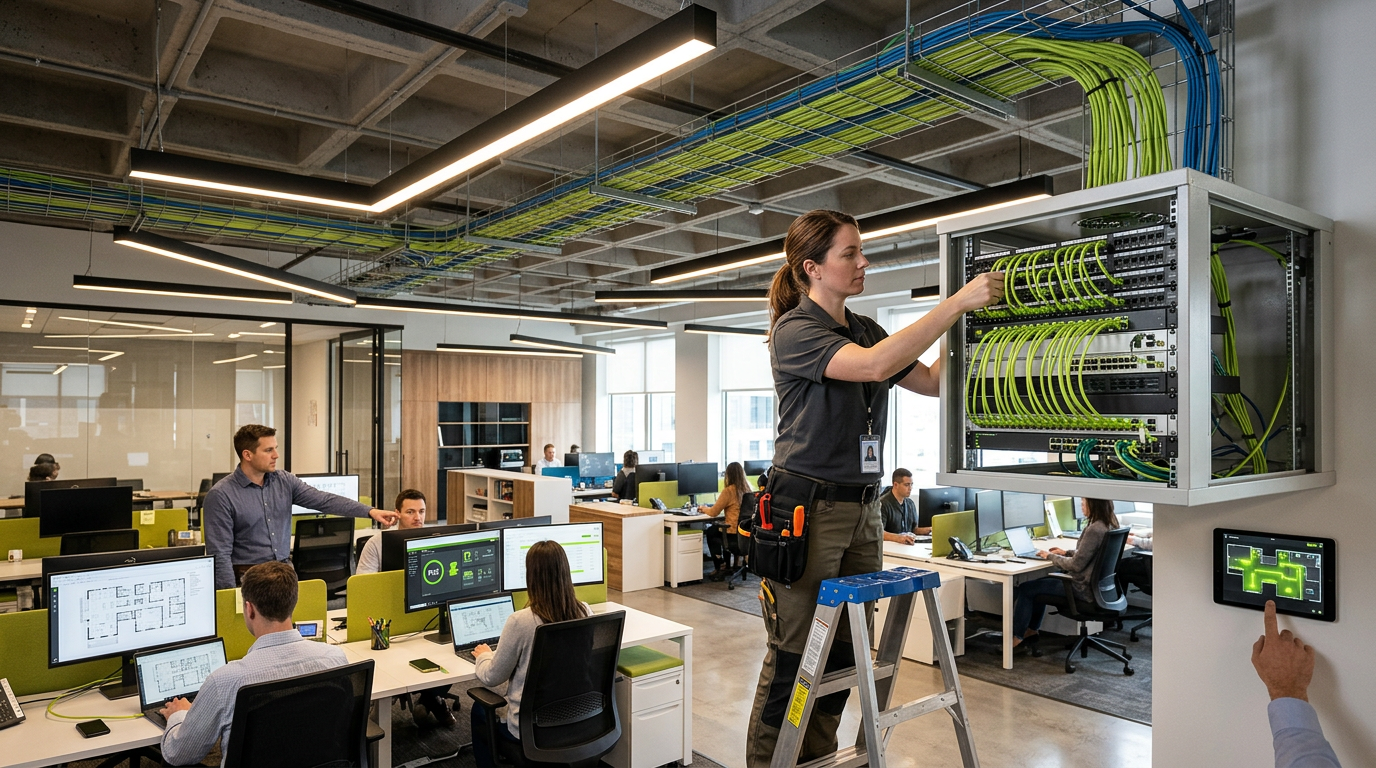
For decades, lighting and data lived in two completely different worlds. Lighting was the domain of high-voltage electrical contractors, while data belonged to IT and low-voltage integrators. Today, those worlds are colliding thanks to the rapid evolution of Power over Ethernet (PoE) lighting.
As businesses across Central Florida look to modernize their facilities, PoE is emerging as the backbone of the truly "smart" building. By delivering both electricity and high-speed data over a single Category 6 (Cat6) cable, PoE lighting is changing how we think about commercial infrastructure.
What is PoE Lighting?
At its core, PoE lighting replaces traditional AC electrical wiring with DC power delivered via standard network cables. Instead of plugging a light fixture into a junction box, the fixture connects to a PoE switch—the same type of hardware that powers your VoIP phones and security cameras.
Because LED technology is inherently low-voltage and DC-based, it is a perfect match for PoE. This eliminates the need for heavy-duty conduits and step-down transformers at every fixture, leading to a more streamlined and flexible installation.
The Benefits of a Unified Infrastructure
Transitioning to a PoE-based lighting system offers several strategic advantages for commercial clients, from retail chains to corporate headquarters.
1. Granular Control and Data Collection
In a traditional setup, you might control an entire floor with one switch. With PoE, every single light fixture becomes an individual node on the network with its own IP address. This allows for:
- Advanced Dimming: Adjusting light levels based on the time of day or task requirements.
- Occupancy Sensing: Lights automatically turn off when a room is vacant, drastically reducing energy waste.
- Daylight Harvesting: Integrated sensors can detect natural light coming through windows and dim the LEDs accordingly to maintain a consistent brightness.
2. Simplified Installation and Scalability
Since PoE lighting relies on Structured Cabling, the installation process is often faster and less invasive than traditional electrical work. For warehouses or large retail environments, this means infrastructure can be reconfigured without tearing out drywall or rerunning heavy-gauge wire. If you move a cubicle or a display rack, you simply move the Ethernet drop.
3. Enhanced Safety and Reliability
PoE operates at a much lower voltage than traditional 120V or 277V systems, reducing the risk of electrical shock and fire. Furthermore, because the lighting is connected to the IT network, it can be integrated with Uninterruptible Power Supplies (UPS). In the event of a power flicker, your critical lighting stays on, ensuring safety for employees and customers.
Integrating with Other Smart Systems
The true power of PoE lighting lies in its ability to communicate with other building systems. When your lighting is on the network, it can "talk" to your other technology stacks:
- Security Systems: If a building alarm is triggered after hours, the PoE system can instantly flash all lights to deter intruders or illuminate exit paths for emergency responders.
- Digital Signage: Lighting levels can be synchronized with digital displays to ensure high-contrast visibility and reduce glare on screens.
- HVAC Integration: Occupancy data from lighting sensors can tell the HVAC system which rooms are empty, allowing the building to scale back cooling in those zones to save on utility costs.
Why Structured Cabling is the Foundation
You cannot have a reliable PoE lighting system without high-quality Structured Cabling. Because these cables are now responsible for both the illumination of your building and the data that controls it, the margin for error is slim.
Industry standards, such as those set by TIA/EIA, are critical here. Factors like cable heat dissipation and signal attenuation must be managed by professional integrators to ensure the network can handle the power load without degrading data speeds. Using high-quality Cat6 or Cat6A cabling ensures that your building is ready for the next decade of technological shifts.
Is PoE Lighting Right for Your Facility?
While PoE lighting is a game-changer for new constructions and major renovations, it is particularly effective in high-density environments like:
- Healthcare: Circadian rhythm lighting to improve patient recovery and staff alertness.
- Education: Creating optimal learning environments through adjustable color temperatures.
- Hospitality: Providing guests with personalized control over their room environment via smartphone apps.
As we move toward a more connected future, the integration of lighting into the IT network is no longer a luxury—it’s a strategic move toward efficiency and intelligence. By leveraging a unified cabling infrastructure, businesses can create spaces that are not only brighter but smarter.
InCTRL Technology Team
Commercial integration specialists with 20+ years installing security, cabling, signage, AV and IT systems across Central Florida. About us
Explore our services
Areas we serve
Need This Done at Your Facility?
Orlando-based since 2004 — 3,300+ jobs completed. Talk to a real technician, not a call center.