Scaling QSR Operations: A Digital Signage Rollout Strategy
Learn how QSR franchises leverage outdoor and indoor digital signage to boost ticket averages and streamline operations across multi-unit rollouts.
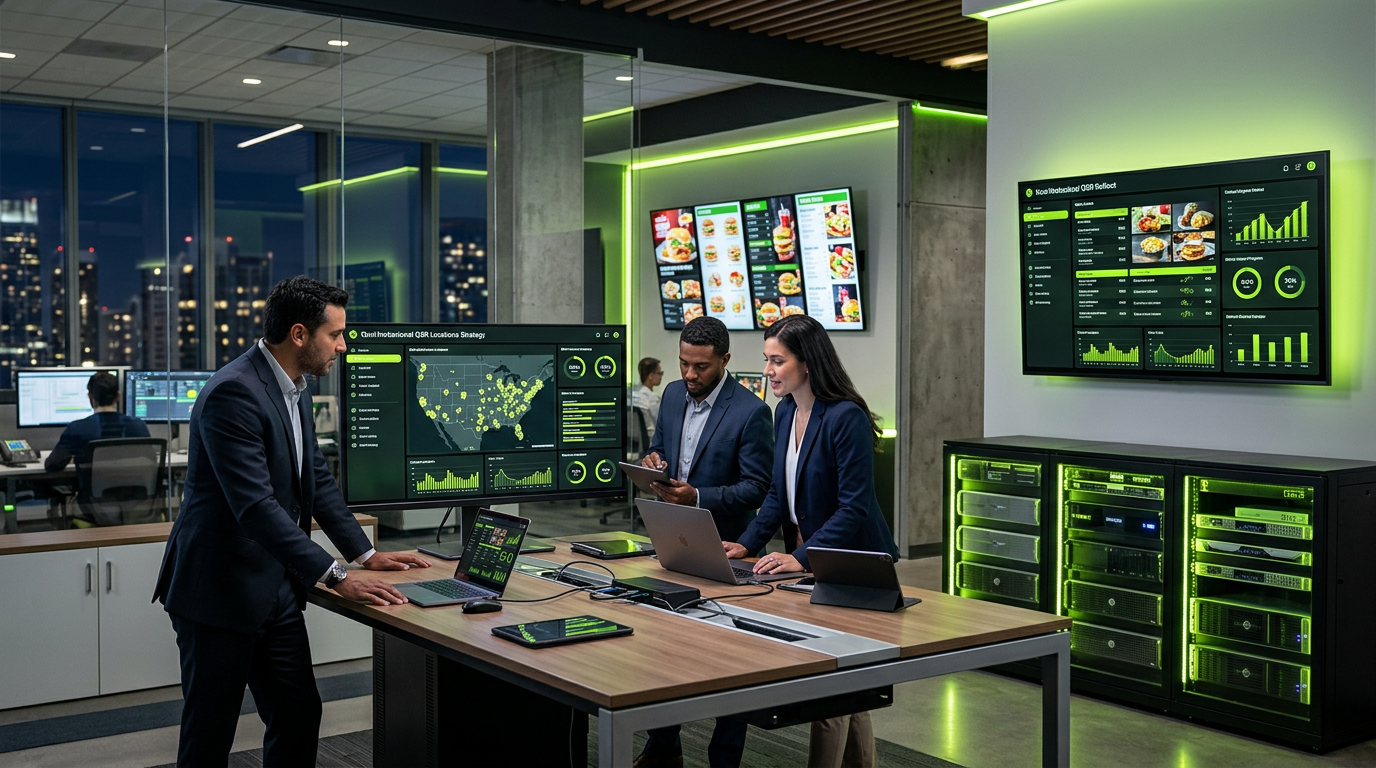
Walk into any high-performing Quick Service Restaurant (QSR) today, and you will notice a shift: the static, backlit plastic menu boards of the past have vanished. In their place are high-brightness, weather-hardened displays that do more than just show prices—they act as real-time sales engines.
For multi-unit franchisees, the transition from analog to digital is no longer a luxury; it is a logistical necessity. Managing price updates, limited-time offers (LTOs), and nutritional compliance across twenty locations manually is a recipe for inconsistency. At InCTRL Technology Services, we’ve seen how a coordinated rollout across the drive-thru and dining room transforms the bottom line.
The Hardware: Built for the Elements
Digital signage in a QSR environment faces two brutal enemies: heat and grease. A consumer-grade television mounted behind a counter will fail within months due to particulates and inadequate cooling.
Professional-grade displays, such as those from Samsung (OH Series) or LG (XE Series), are rated for 24/7 operation. In the drive-thru, these units must feature high-nit brightness (typically 2,500 to 3,500 nits) to remain visible in direct Florida sunlight. They also require IP56-rated enclosures to withstand heavy rain and humidity without internal condensation.
The Infrastructure: The Backbone of the Rollout
You cannot have a reliable digital menu without a solid foundation of Structured Cabling. During a rollout, we focus on three critical components:
- Category 6A Shielded Cabling: To prevent electromagnetic interference and support the high-bandwidth requirements of 4K content delivery.
- Power over Ethernet (PoE) Solutions: Reducing the need for high-voltage electrical runs at every screen location, where applicable.
- Network Segmentation: Ensuring the digital signage traffic is isolated from the Point of Sale (POS) and guest Wi-Fi to maintain security and prevent lag.
Data-Driven Dining: The ROI of Dynamic Content
The real power of a digital rollout lies in Dayparting. Through a centralized Content Management System (CMS), a franchise owner can automatically switch from breakfast to lunch menus at precisely 10:30 AM across all locations.
Furthermore, modern systems integrate with inventory data. If a specific location runs out of a seasonal item, the CMS can instantly remove that item from the board, preventing customer frustration at the window. This agility directly impacts throughput—the faster a customer can decide, the higher the car count per hour.
Cost vs. Value: The Ballpark Breakdown
When planning a QSR rollout, stakeholders often focus on the upfront capital expenditure. However, the value is realized through reduced labor costs and increased average transaction value (ATV).
Initial Investment (Per Location):
- Indoor Menu Boards (3-Screen Array): $6,000 – $9,000 (Includes professional displays, mounts, and media players).
- Outdoor Drive-Thru (Dual or Triple Pedestal): $15,000 – $25,000 (Includes high-brightness weather-rated displays and structural mounting).
- Installation & Structured Cabling: $3,000 – $5,000 (Depending on site conditions and existing infrastructure).
The Value Return:
- Elimination of Printing Costs: Large-scale franchises spend upwards of $2,000 per year, per location on physical menu inserts and shipping.
- Increased ATV: Industry data suggests that dynamic upselling (e.g., a high-margin beverage animation appearing after a meal is selected) can increase ticket averages by 3% to 5%.
- Labor Efficiency: Removing the need for employees to manually change outdoor signage or indoor boards saves approximately 20-30 man-hours per year.
Lessons from the Field: Avoiding Deployment Pitfalls
In our experience across Central Florida, the biggest hurdle in a digital rollout isn't the technology—it's the environment. We recently consulted on a project where a client attempted to use standard enclosures in a high-humidity coastal area. The result was a total system failure within six months due to salt-air corrosion.
For a successful rollout, we recommend a Pilot-to-Scale approach:
1. Site Audit: Assess existing power and network capacity at each franchise location.
2. Standardization: Use the same hardware and mounting kits across all sites to simplify future maintenance.
3. Redundancy: Ensure your CMS has an "offline mode" so that menus remain visible even if the internet goes down.
Moving Forward
As we look toward 2026, the integration of AI-driven analytics will be the next step. Cameras equipped with computer vision can already track dwell times and demographic data to serve personalized ads on the fly. By getting the physical infrastructure—the cabling and the displays—right today, QSR owners are setting the stage for the next decade of retail technology.
Sources
- [2026 Warehouse Security Guide: Systems, Cameras & ...](https://www.eufy.com/blogs/security-camera/warehouse-security)
- [Warehouse Surveillance Systems Charlotte: The 2026 ...](https://www.utdtechnology.com/network-infrastructure/warehouse-surveillance-systems-charlotte-the-2026-strategic-security-guide/)
- [Warehouse Security Challenges 2026 | Gcctvms — Solutions](https://www.linkedin.com/pulse/warehouse-security-challenges-2026-gcctvms-solutions-globalcctvms-exrbf)
InCTRL Technology Team
Commercial integration specialists with 20+ years installing security, cabling, signage, AV and IT systems across Central Florida. About us
Explore our services
Areas we serve
Need This Done at Your Facility?
Orlando-based since 2004 — 3,300+ jobs completed. Talk to a real technician, not a call center.