OSDP vs. Wiegand: Choosing the Right Access Control Standard
A technical comparison of OSDP and Wiegand standards for commercial access control, focusing on encryption, wiring efficiency, and security risks.
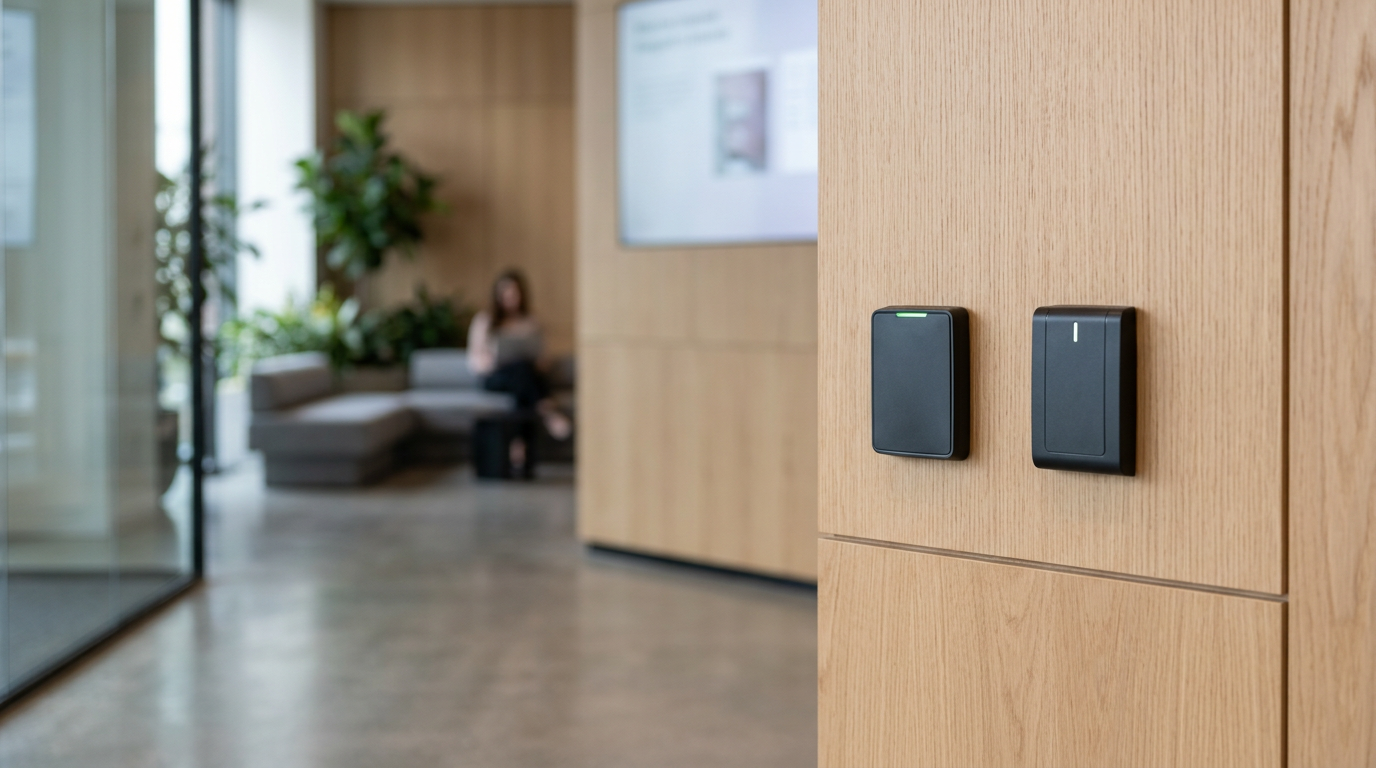
OSDP is the superior choice for new commercial installations because it supports AES-128 encryption and bidirectional communication. Wiegand remains a viable, lower-cost option only for low-risk internal doors or legacy system expansions where existing multi-conductor cabling cannot be replaced. For any perimeter or high-security entrance, OSDP with Secure Channel is the modern standard.
Quick Facts
- Encryption: OSDP supports AES-128 encryption via Secure Channel; Wiegand transmits all credential data in plain text.
- Distance: OSDP functions at ranges up to 4,000 feet using RS-485, while Wiegand is limited to approximately 500 feet.
- Supervision: OSDP provides continuous reader-to-controller heartbeats to detect tampered or offline devices instantly.
- Cabling: OSDP requires only two wires for data (twisted pair), whereas Wiegand requires 5 to 7 conductors for basic LED and buzzer control.
- Standardization: OSDP is governed by the Security Industry Association (SIA) and recognized as IEC 60839-11-5.
Technical Specification Comparison
| Feature | Wiegand (Legacy) | OSDP v2.2 (SIA Standard) |
|---|---|---|
| Communication Type | One-way (Reader to Controller) | Bidirectional (Full Command/Reply) |
| Data Security | None (Vulnerable to sniffing/replay) | AES-128 Encryption (Secure Channel) |
| Wiring Topology | Home-run only | Point-to-point or Multi-drop bus |
| Max Cable Length | 500 ft (150m) | 4,000 ft (1,200m) |
| Reader Supervision | None | Real-time monitoring & tamper alerts |
| Firmware Updates | Manual at the reader | Remote via the controller |
The Wiegand Vulnerability Gap
For decades, Wiegand has been the backbone of the security industry. It is simple and works across almost every brand of hardware. However, Wiegand has a fundamental flaw: it is a one-way, unencrypted protocol. When a user taps a card, the reader sends the raw card number over the wires as a series of electrical pulses.
In a commercial environment, any intruder with access to the physical wiring—perhaps behind a poorly secured reader on an exterior wall—can use a small, inexpensive device to intercept that signal. They can then replay the signal to the controller to open the door. Because Wiegand is one-way, the controller has no way to verify if the reader is still there or if the signal is legitimate.
Why OSDP Wins for New Construction
OSDP (Open Supervised Device Protocol) was designed to solve the security and installation limitations of Wiegand. By moving to a bidirectional RS-485 signaling method, OSDP allows the controller and the reader to "talk" to each other.
This bidirectional nature enables Secure Channel. During the initial handshake, the reader and controller exchange encryption keys. All card data sent across the wires is then encrypted using AES-128. Even if a bad actor taps the wires, they see only encrypted noise. Furthermore, if the wires are cut or the reader is swapped with a fraudulent device, the controller immediately triggers a tamper alarm because the "heartbeat" signal is interrupted.
From an installation perspective, OSDP is significantly more efficient. Because it uses a bus architecture, you can technically daisy-chain multiple readers on a single four-conductor cable run (data plus power), though most Central Florida facilities still prefer home-runs for easier troubleshooting.
What This Means in Central Florida
In Florida, the environment dictates hardware longevity. The humidity and salt air along the coast can lead to copper oxidation in low-voltage connections. OSDP is advantageous here because it uses fewer conductors, reducing the number of potential failure points in a junction box.
Lightning is the other major factor. With the frequent afternoon storms in Orlando and Tampa, long outdoor cable runs are prone to surges. OSDP’s ability to run over 4,000 feet is impressive, but for Florida warehouses or gated parking lots, we still recommend using surge protection at both ends of the run. If you are retrofitting an older building in Ocala or Kissimmee that already has multi-conductor 18/6 or 22/6 wire in the walls, that legacy wire can often be reused for OSDP, provided the twists are sufficient for RS-485 data rates.
Frequently Asked Questions
Can I use OSDP readers with my existing Wiegand controller?
Most modern controllers are hybrid and support both standards, but you must check the specific port configuration. If your controller is Wiegand-only, you will need an OSDP-to-Wiegand converter, though this eliminates the encryption benefits between the converter and the controller.
Does OSDP cost more than Wiegand hardware?
In 2026, the price gap has narrowed significantly. OSDP-capable readers typically carry a 10% to 15% premium over basic Wiegand models. However, the labor savings from reduced wiring complexity and the elimination of manual firmware updates often offset the higher hardware cost.
Is OSDP harder to program than Wiegand?
It requires an extra step to "bond" the reader to the controller using a secure encryption key. While Wiegand is truly plug-and-play, it is also "plug-and-hack." The minor extra configuration time for OSDP is a necessary trade-off for a secure, supervised perimeter.
Can OSDP run over my existing CAT6 network cabling?
Yes, OSDP performs very well over a single twisted pair within a CAT6 cable. This makes it an excellent choice for modern offices where structured cabling is already pulled to every door location, allowing for high-speed data and reliable power delivery.
What happens if an OSDP reader fails?
Because the protocol is supervised, your security software will immediately flag a "Communication Lost" event. Replacing the reader requires re-authorizing the new hardware at the controller, which prevents an unauthorized person from simply swapping in a compromised reader to bypass security.
---
Planning a project like this? See our [security camera installation services](/services/security-cameras) or [get a free site assessment](/contact) from InCTRL's Orlando team.
Sources
- [OSDP Vs Wiegand: Why Secure Channel Matters In 2026](https://sen.news/osdp-vs-wiegand-secure-channel/)
- [Biometric Access Control System: How It Works & Why ...](https://bioconnect.com/blog/biometric-access-control-system-how-it-works-why-central-management-matters)
- [RFID Access Control Systems: 2026 Costs & Reader Guide](https://swiftlane.com/blog/rfid-access-control/)
InCTRL Technology Team
Commercial integration specialists with 20+ years installing security, cabling, signage, AV and IT systems across Central Florida. About us
Explore our services
Areas we serve
Need This Done at Your Facility?
Orlando-based since 2004 — 3,300+ jobs completed. Talk to a real technician, not a call center.