Which microphones prevent audio echo in large Orlando boardrooms?
To prevent audio echo in large boardrooms, you require beamforming ceiling microphone arrays or tabletop microphones paired with a dedicated Acoustic Echo Cancellation (AEC) processor. These systems isolate speech from speaker output, ensuring remote participants do not hear their own voices delayed through the room’s speakers.
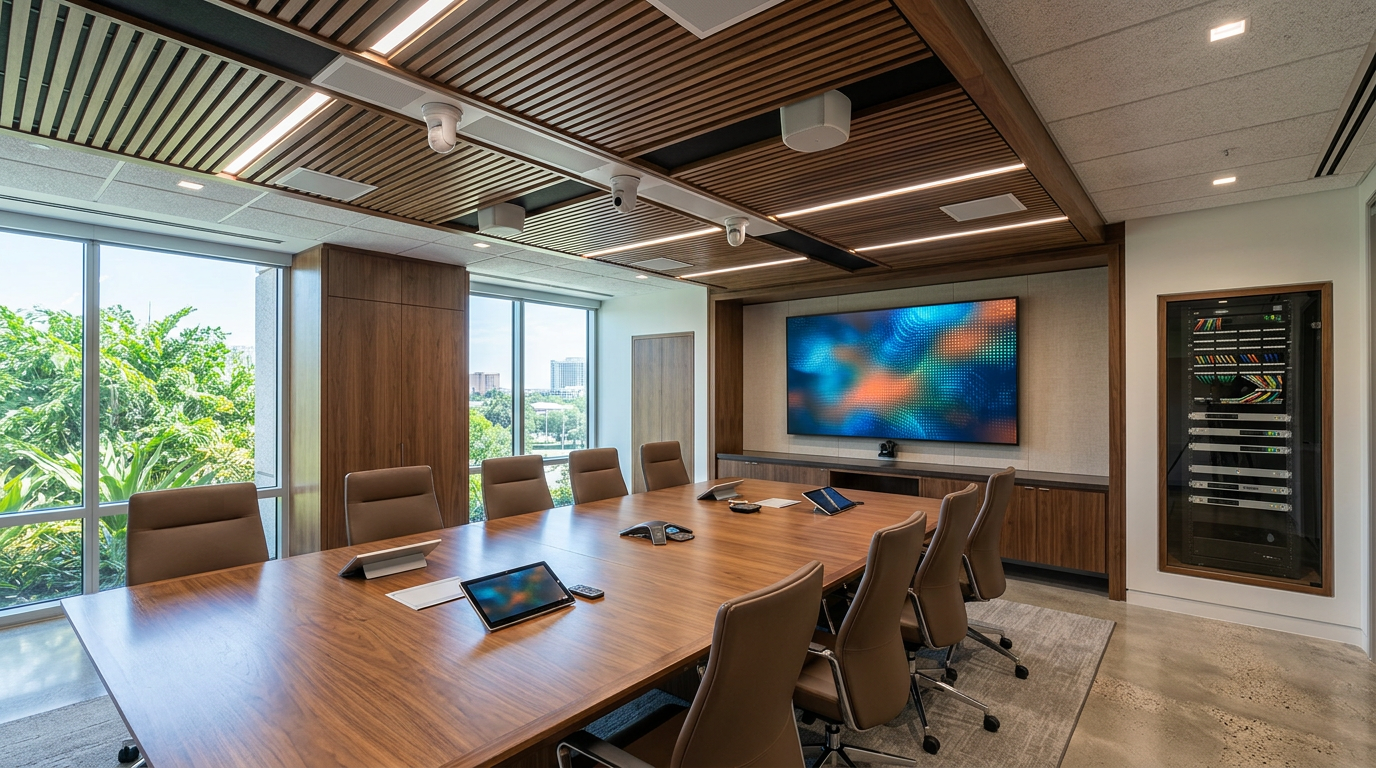
To prevent audio echo in large boardrooms, you require beamforming ceiling microphone arrays or tabletop microphones paired with a dedicated Acoustic Echo Cancellation (AEC) processor. These systems isolate speech from speaker output, ensuring remote participants do not hear their own voices delayed through the room’s speakers. Professional-grade hardware from brands like Biamp or Q-SYS is standard for spaces exceeding 20 feet.
Quick Facts
- AEC Standard: Acoustic Echo Cancellation (AEC) is the software or hardware process that removes the speaker's output from the microphone's pickup.
- Pickup Range: Modern ceiling microphone arrays typically cover a 20-foot to 30-foot diameter per unit.
- Connection Type: Professional boardroom microphones in 2026 primarily use Dante or AES67 (Audio over IP) via Category 6 cabling.
- Latency Target: System latency must remain below 150ms to prevent perceptible speech disruption for remote callers.
- Acoustic Rating: Large Florida boardrooms with glass walls often require microphones with a high direct-to-reverberant ratio to combat 80ms+ echo tails.
| Microphone Type | Typical Cost (Installed) | Best For |
|---|---|---|
| Ceiling Array | $3,500 – $6,500 per unit | Clean aesthetics and large tables |
| Tabletop Gooseneck | $600 – $1,200 per seat | High-stakes voting or noisy environments |
| All-in-One Video Bar | $1,500 – $3,500 per room | Small to medium huddle spaces |
The Role of Acoustic Echo Cancellation (AEC)
Echo in a boardroom occurs when the sound from the room’s speakers is picked up by the room’s microphones and sent back to the remote caller. In large spaces, this is exacerbated by high ceilings and hard surfaces like glass or tile. To stop this, you need a Digital Signal Processor (DSP) with AEC.
The DSP takes a "reference" feed from the incoming far-end audio. It then digitally subtracts that specific sound from the microphone signal before it is transmitted. Without a dedicated AEC processor, even the most expensive microphone will still produce echo in a software-based environment like Microsoft Teams or Zoom if the room volume is high.
Beamforming Technology in Large Spaces
Large Orlando boardrooms often utilize beamforming ceiling arrays. Unlike traditional microphones that pick up sound in a wide circle, beamforming arrays create narrow "lobes" or beams that follow the person speaking.
These systems use dozens of internal microphone elements to calculate the location of a voice. By ignoring the rest of the room—including air conditioning hum or paper rustling—they provide a much higher signal-to-noise ratio. This directional pickup makes it significantly easier for the AEC processor to distinguish between a local speaker and the audio coming out of the ceiling speakers.
Wiring and Infrastructure Standards
In 2026, the standard for boardroom audio is structured cabling. We no longer run thick analog XLR cables through conduits for professional arrays. Instead, we use Cat6 cabling to transmit audio over the network using the Dante protocol. This allows us to power the microphones via Power over Ethernet (PoE) and route dozens of audio channels over a single cable. Following TIA-568 standards for this cabling ensures that there is no signal loss or interference that could degrade audio quality or cause digital "jitter" during a call.
What This Means in Central Florida
Orlando boardrooms face unique acoustic challenges due to modern architecture. Many local offices feature floor-to-ceiling glass to showcase views, which creates highly reflective "bright" rooms. Additionally, Florida’s high-velocity HVAC systems, required to combat humidity, generate significant background noise. Selecting microphones with advanced noise-tracking and pairing them with ASTM C-423 rated acoustic panels is often necessary to achieve professional-grade clarity in the Central Florida climate.
Frequently Asked Questions
Can I use a high-end webcam microphone for a 20-person boardroom?
No. Webcam microphones are designed for a 3-foot to 5-foot range. In a large boardroom, they will pick up too much room reflection and background noise. For 20 people, you need at least two ceiling arrays or individual tabletop microphones to ensure every participant is heard clearly without echo.
Why does my boardroom echo only when the volume is turned up?
This happens when the "loopback" gain exceeds the capabilities of your echo cancellation software. When the speakers are loud, the sound bounces off walls and enters the microphone at a high volume. If your system relies on basic software AEC instead of a dedicated hardware DSP, it cannot process the data fast enough to remove the echo.
Is wireless better than wired for boardroom microphones?
Wireless microphones offer flexibility for divisible rooms but require constant battery management and are susceptible to RF interference. For a permanent boardroom, wired Cat6 microphones are superior because they provide a more stable connection, lower latency, and do not require charging between meetings.
Do ceiling microphones pick up the sound of the air conditioning?
Professional beamforming microphones include digital noise reduction specifically tuned to ignore constant frequencies like HVAC hum. However, if the AC vents are blowing directly onto the microphone face, it will cause mechanical noise. Proper placement away from diffusers is a standard requirement for Florida installations.
How many microphones do I need for a 30-foot table?
Typically, a 30-foot table requires two high-end beamforming ceiling arrays or one microphone for every two participants if using tabletop units. Over-provisioning microphones is better than under-provisioning, as it allows the system to pick up quiet speakers without increasing the "gain" to a level that causes feedback.
---
Planning a project like this? See our [audio visual installation services](/services/audio-visual) or [get a free site assessment](/contact) from InCTRL's Orlando team.
Sources
- [Conference Room AV Solutions in Melbourne, Orlando & Central Florida](https://im.solutions/conference-rooms-av/)
- [Professional Church Soundproofing Florida | Sanctuary Acoustic Solutions](https://florida-soundproofing.com/church-soundproofing-florida/)
- [Conference Room AV Installation | Audio Visual Solutions](https://avmeetings.com/integration/conference-rooms/)
InCTRL Technology Team
Commercial integration specialists with 20+ years installing security, cabling, signage, AV and IT systems across Central Florida. About us
Explore our services
Areas we serve
Need This Done at Your Facility?
Orlando-based since 2004 — 3,300+ jobs completed. Talk to a real technician, not a call center.