How long does a professional site survey take for commercial security cameras?
A professional site survey for commercial security cameras typically takes 1.5 to 4 hours for facilities between 5,000 and 25,000 square feet. Large industrial complexes or multi-story offices may require 6 to 8 hours.
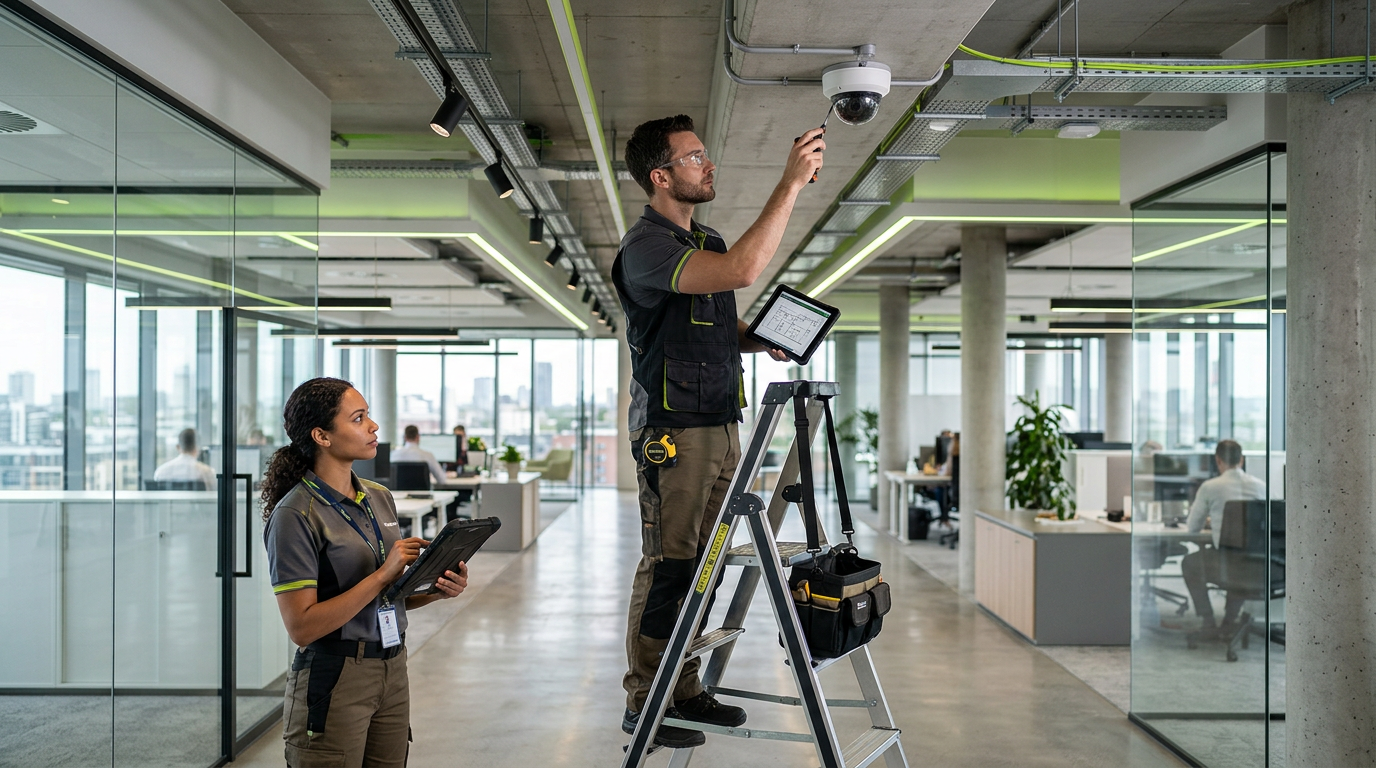
A professional site survey for commercial security cameras typically takes 1.5 to 4 hours for facilities between 5,000 and 25,000 square feet. Large industrial complexes, multi-story office buildings, or outdoor campuses exceeding 50,000 square feet often require 6 to 8 hours. The duration depends on facility size, mounting heights, and cable path complexity.
Quick Facts
- Small Retail/Office (Under 5,000 sq ft): 60 to 90 minutes for a comprehensive walkthrough.
- Standard Commercial (10,000–30,000 sq ft): 2 to 4 hours to map all 15–30 camera locations and IDF closets.
- Industrial/Warehouse (50,000+ sq ft): 4 to 8 hours, accounting for high-ceiling lift requirements and long cable runs.
- Data Documentation: 30% of survey time is spent documenting existing network switches and PoE (Power over Ethernet) budgets.
- Outdoor Perimeters: 1 to 2 additional hours to verify line-of-sight for wireless bridges or trenching paths for gate cameras.
| Facility Type | Survey Duration | Typical Camera Count | Focus Areas |
|---|---|---|---|
| Small Retail / Quick Service | 1 - 1.5 Hours | 4 - 8 Cameras | Cash wraps, entry/exit, back office |
| Professional Office (1 Floor) | 2 - 3 Hours | 10 - 20 Cameras | Server room, lobby, hallways, exits |
| Warehouse / Distribution | 4 - 6 Hours | 20 - 50+ Cameras | Loading docks, rack aisles, perimeter |
| Multi-story Hotel / Condo | 6 - 8 Hours | 40 - 100+ Cameras | Elevators, stairwells, amenities, parking |
Factors Influencing Survey Duration
The primary driver of site survey time is the physical complexity of the building. A 20,000-square-foot open-plan warehouse is significantly faster to survey than a 10,000-square-foot medical facility with dense wall partitions and lead-lined rooms. Technicians must verify the composition of walls (drywall vs. CMU block) and the type of ceiling (drop-tile vs. open plenum) to determine labor hours for cable pulls.
Network infrastructure assessment also adds time. A professional integrator does not just look at mounting points; they must inspect the IT closet. This includes verifying available rack space, checking the wattage capacity of existing PoE switches, and measuring cable distances to ensure they fall within the TIA-568 standard of 100 meters (328 feet). If runs exceed this limit, the survey must include time to identify locations for mid-span injectors or fiber-optic extensions.
Lighting and Field of View Testing
For high-security environments in Tampa, a survey may include a "night-time lux test" or a demonstration with a mobile tripod. Testing how existing parking lot lighting interacts with infrared (IR) sensors or Wide Dynamic Range (WDR) settings ensures there are no blind spots caused by glare or deep shadows. Mapping these fields of view (FoV) on a digital floor plan typically adds 30 to 60 minutes to the total assessment but prevents costly camera relocations after the installation begins.
Compliance and Regulatory Review
In Florida, commercial surveillance must adhere to specific legal and safety standards. During the survey, technicians must identify "areas of expected privacy" where cameras cannot be installed, such as restrooms or locker rooms, to ensure compliance with Florida Statute 810.145. Additionally, for businesses requiring NDAA-compliant hardware (National Defense Authorization Act), the surveyor must audit any existing legacy equipment to ensure the new system integrates without violating federal procurement guidelines.
What This Means in Central Florida
In the Tampa Bay and Orlando corridors, humidity and salt air significantly impact hardware selection. A site survey in coastal areas like Clearwater or St. Pete requires an extra 30 minutes to inspect exterior mounting surfaces for corrosion and to specify IP66 or IP67-rated weatherproofing. Furthermore, afternoon thunderstorms and hurricane-season wind loads mean technicians must verify that exterior mounts are secured to structural members rather than just aluminum soffits. Drive times from our Orlando hub to Tampa or Lakeland are factored into scheduling to ensure a full daylight window for exterior inspections.
Frequently Asked Questions
Do I need to be present for the entire site survey?
It is highly recommended that a facility manager or IT director is present for the first 30 minutes to discuss security pain points and the final 20 minutes for a summary walkthrough. Access to IT closets, mechanical rooms, and roof hatches must be pre-arranged to avoid delays.
What documentation should I receive after the survey is complete?
Following a professional survey, you should receive a detailed proposal including a floor plan with camera icons, a bill of materials (BOM) specifying camera models and storage capacity, and a scope of work (SOW) detailing cable paths and network requirements.
Can a site survey be done virtually using floor plans?
While a preliminary quote can be generated using tools like Google Earth or architectural PDFs, a physical survey is required to identify obstructions like HVAC ducts, verify cable path feasibility, and check the health of existing network switches to prevent mid-project change orders.
Does a site survey include checking existing cabling?
Yes, a professional integrator will test existing Category 5e or Category 6 cables for continuity and bandwidth capacity. If the existing copper is degraded or does not meet TIA-568 standards for 4K video transmission, the survey will identify the need for new structured cabling.
How soon after the survey can I expect the installation to begin?
Typically, a formal proposal is delivered within 48 to 72 hours of the survey. Once the proposal is signed and equipment is ordered, installation usually begins within 7 to 14 days, depending on permit requirements and hardware lead times.
---
Planning a project like this? See our [security camera installation services](/services/security-cameras) or [get a free site assessment](/contact) from InCTRL's Orlando team.
Sources
- [Professional Security Camera Installation in Tampa, FL](https://www.arceyedefense.com/security-camera-installation-tampa-fl)
- [Commercial CCTV in Tampa Bay: Complete Guide to Business ...](https://primeprotectionllc.com/2026/09/22/commercial-cctv-tampa-bay/)
- [Business Security Camera Installation in Tampa Bay - SightLine Networks](https://sightlinenetworks.com/security-camera-installation)
InCTRL Technology Team
Commercial integration specialists with 20+ years installing security, cabling, signage, AV and IT systems across Central Florida. About us
Explore our services
Areas we serve
Need This Done at Your Facility?
Orlando-based since 2004 — 3,300+ jobs completed. Talk to a real technician, not a call center.