Why 4K Cameras Are Useless Without a Fiber Backbone
Learn why high-resolution security at Florida ports fails without high-capacity structured cabling and how to build a resilient surveillance network.
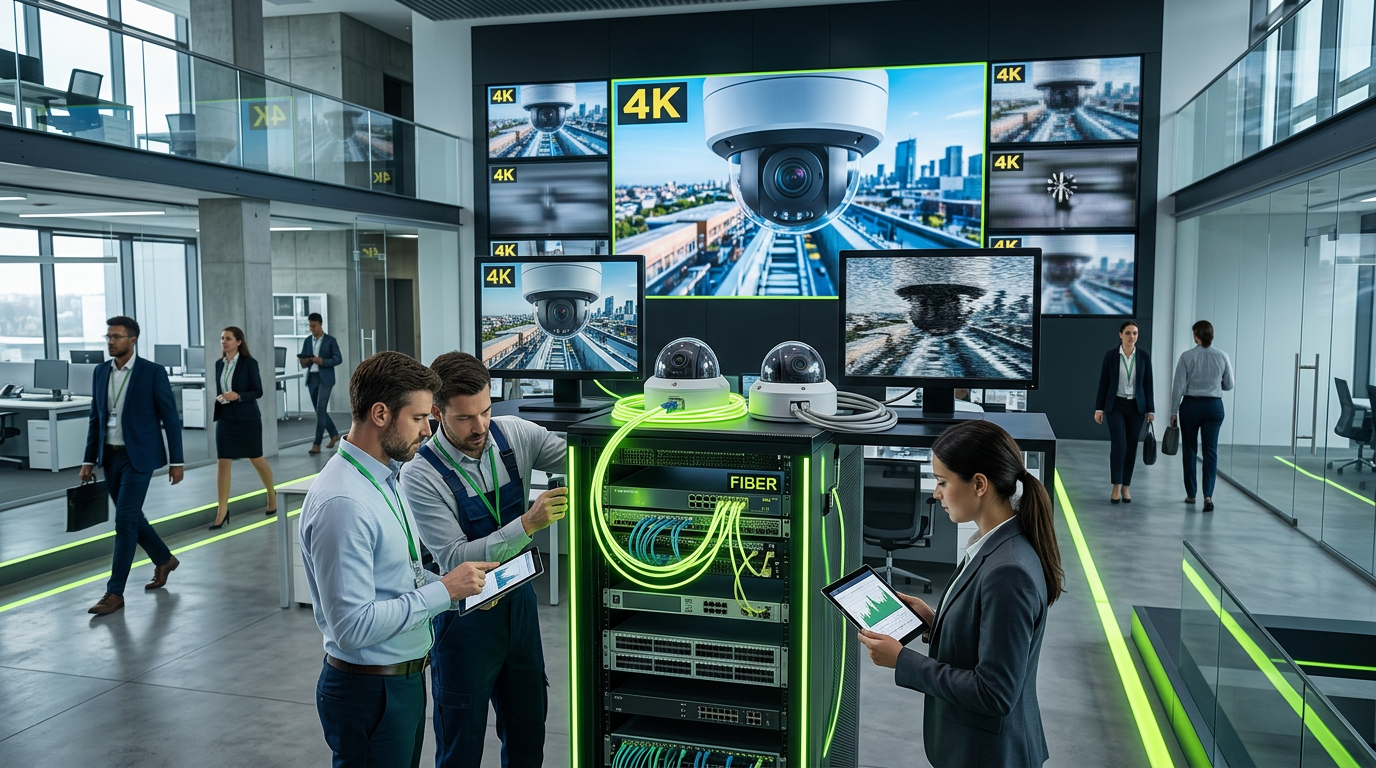
Most security integrators will tell you that the secret to a secure port facility lies in the resolution of the glass. They’ll push 4K, 8K, and thermal imaging as the silver bullet for maritime security.
Here is the uncomfortable truth: A 4K camera is a liability, not an asset, if your cabling infrastructure wasn’t built to handle it.
In the high-stakes environment of Florida’s ports and logistics hubs, we often see facilities investing hundreds of thousands of dollars in high-end optics, only to experience dropped frames, latency, and "ghosting" during critical security events. The bottleneck isn't the camera; it's the copper. To truly fortify a port, you have to stop thinking about cameras and start thinking about the light moving behind the scenes.
The Bandwidth Trap in Maritime Logistics
Florida ports are sprawling, harsh environments. When you move from a standard 1080p stream to a 4K (8MP) stream, you aren't just doubling the quality; you are exponentially increasing the data load on your network.
Standard Category 6 (Cat6) copper cabling is excellent for office environments, but it has a hard physical limit of 100 meters (328 feet). In a warehouse or port setting, where camera runs often stretch across loading docks and perimeter fences, pushing copper to its limit results in signal degradation.
When a security operator in a central command center tries to digital-zoom into a container ID or a license plate, a weak network will pixelate the image exactly when clarity is needed most. This is why High-Capacity Fiber Optics are no longer optional—they are the foundation of modern maritime surveillance.
Why Fiber is the Gold Standard for Florida Ports
Unlike copper, fiber optic cabling uses light to transmit data. For Florida port facilities, this offers three non-negotiable advantages:
- Distance Without Degradation: Fiber can carry 4K video signals for miles, not just feet, without the need for mid-span boosters or extra IDF closets.
- Immunity to Interference: Ports are industrial zones filled with heavy machinery, cranes, and large electrical motors. These create Electromagnetic Interference (EMI) that can scramble data on copper wires. Fiber is immune to EMI.
- Lightning Resilience: In Central Florida, lightning is a constant threat. Because glass fiber does not conduct electricity, it provides a natural layer of protection for your expensive network switches against outdoor surges.
The Power of 4K and AI Analytics
Once a robust fiber backbone is in place, 4K cameras finally get to do what they were designed for. In a port or large-scale warehouse, the goal isn't just to see "someone" is there; it's to identify *who* and *what*.
Modern 4K systems paired with AI Analytics allow for:
- Optical Character Recognition (OCR): Automatically reading and logging shipping container numbers as they pass through gates.
- Advanced Perimeter Protection: Distinguishing between a stray animal at the fence line and a human intruder, significantly reducing false alarms.
- Low-Light Performance: With high-resolution sensors, cameras can utilize IR Night Vision and low-light technology to maintain full-color images in near-total darkness, which is vital for 24/7 port operations.
Integration: More Than Just Security
At InCTRL Technology Services, we view these installations as holistic business tools. A port's technology stack shouldn't just be about "catching the bad guy." When high-capacity fiber and 4K cameras are integrated correctly, they serve multiple departments:
1. Operations: Yard managers can monitor traffic flow and gate congestion in real-time from a mobile device or a central digital signage dashboard.
2. Safety: High-resolution footage helps health and safety officers review incidents or near-misses with granular detail to improve training protocols.
3. Liability: In the event of cargo damage, having crystal-clear, timestamped 4K video can save a facility millions in insurance disputes.
Building for 2026 and Beyond
The industry is moving toward "Smart Ports." As we look toward the next few years, the demand for data will only increase. By installing a high-strand-count Single Mode Fiber backbone now, Florida facilities are not just solving today's security problems—they are prepping the site for future technologies like 5G private networks and autonomous yard tractors.
If you are still relying on a patchwork of copper extenders and aging analog-to-digital converters, your security is standing on a shaky foundation. Fortifying a facility requires a shift in perspective: prioritize the pipe, then the picture.
Sources
- [Warehouse Security Systems for Enhanced Safety and Profit](https://www.truehomeprotection.com/business/industries/warehouse-security-systems/)
- [What Security Does a Warehouse Need? | Aurora, IL](https://sentrysecurity.com/what-security-does-a-warehouse-need/)
- [Best Business Security Systems of 2026](https://www.security.org/home-security-systems/best/business/)
InCTRL Technology Team
Commercial integration specialists with 20+ years installing security, cabling, signage, AV and IT systems across Central Florida. About us
Explore our services
Areas we serve
Need This Done at Your Facility?
Orlando-based since 2004 — 3,300+ jobs completed. Talk to a real technician, not a call center.