The Future of Florida Hospitality: 4K LED Walls vs. Projectors
Discover why Florida hospitality leaders are trading traditional projectors for 4K LED video walls to enhance guest experiences and ROI.
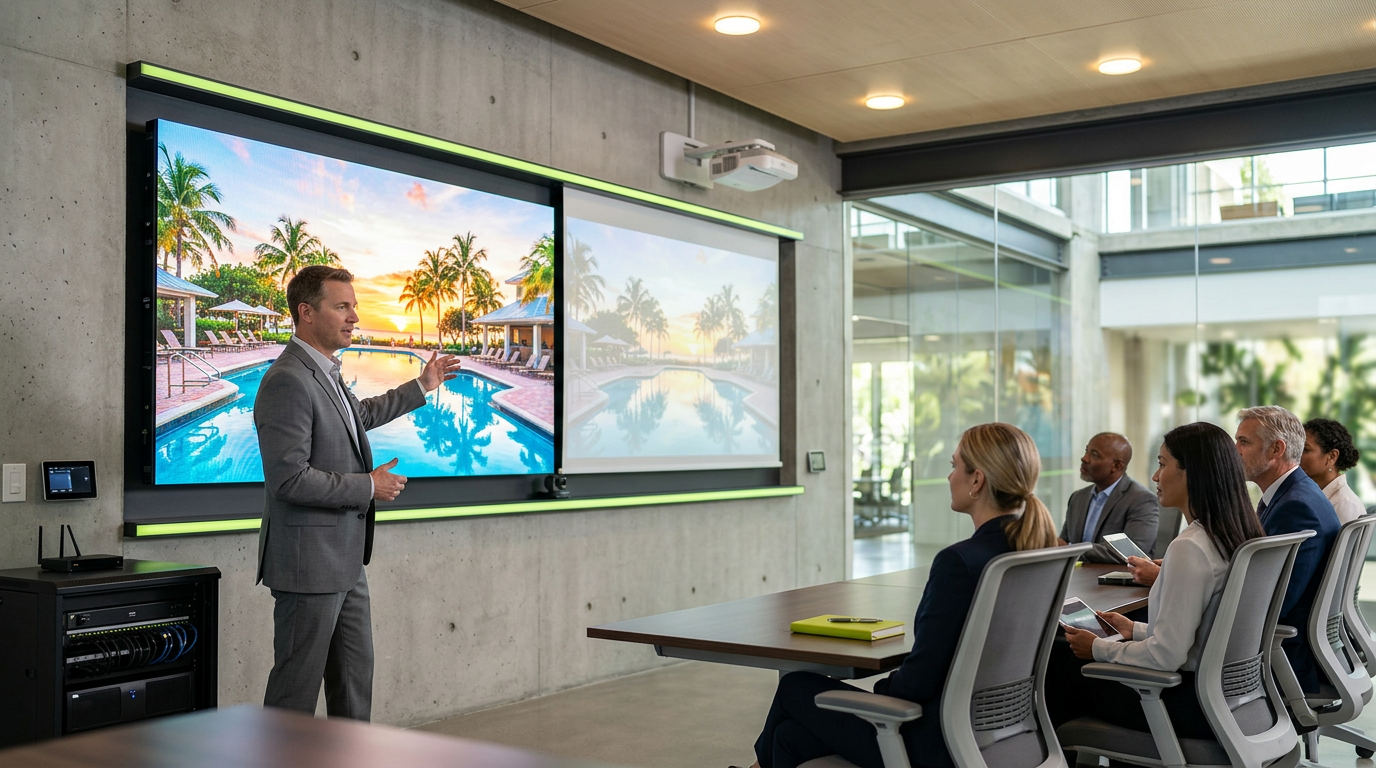
Walk into a high-end resort lobby in Orlando or a luxury hotel ballroom in Miami, and you will notice a distinct shift in the atmosphere. The dim, recessed lighting once required to view a presentation screen is being replaced by vibrant, high-contrast imagery that competes successfully with the bright Florida sun.
As we look toward 2026, the hospitality industry is reaching a tipping point. The traditional projector-and-screen setup, a staple of event spaces for decades, is rapidly losing ground to Direct View LED (dvLED) video walls. While both technologies aim to deliver visual content, the infrastructure, maintenance, and guest experience they offer couldn't be more different.
The Rise of the LED Video Wall
Direct View LED technology has evolved from the grainy, low-resolution displays seen at sports stadiums into sophisticated 4K and 8K canvases. Unlike a projector, which bounces light off a surface, LED walls consist of millions of tiny light-emitting diodes that produce their own light.
For Florida hoteliers, this solves a chronic problem: ambient light. In a state known for floor-to-ceiling windows and bright outdoor spaces, projectors often struggle with washed-out images. LED walls thrive in these environments, offering brightness levels that remain crisp even in broad daylight.
Comparing the Contenders: LED vs. Projection
To understand which technology fits your facility, it helps to look at where each shines—and where they fall short.
The Case for LED Video Walls
- Seamless Aesthetics: LED panels interlock without visible seams, creating a continuous digital canvas of any size or shape.
- Longevity: Most LED displays are rated for 100,000 hours of use. In contrast, projector bulbs and lasers often require replacement or significant maintenance much sooner.
- Space Efficiency: LED walls are thin and wall-mounted. You don't need to worry about "throw distance" or guests walking in front of the lens and casting shadows on the presentation.
- Color Accuracy: With HDR capabilities, LED provides deeper blacks and more vibrant colors, essential for high-end corporate branding at conferences.
The Case for Projectors
- Initial Cost: For organizations on a tight budget, high-lumen projectors still offer a lower entry price for large-scale images.
- Portability: In multi-purpose rooms where a permanent installation isn't feasible, a motorized screen and a portable projector offer flexibility.
- Non-Standard Surfaces: Projector mapping allows you to throw images onto curved walls or architectural features, which is difficult (though not impossible) with rigid LED panels.
The Infrastructure Backbone: Why Standards Matter
Upgrading to a 4K LED wall isn't just about hanging panels; it’s about the Structured Cabling that feeds the beast. High-resolution video walls require massive data throughput and stable power.
As the industry looks toward the upcoming ANSI/BICSI N1-2019 revisions regarding ICT installation practices, it is more important than ever to ensure your AV integration follows gold-standard protocols. Proper cable management, heat dissipation analysis, and signal integrity are the difference between a breathtaking display and a flickering headache.
At InCTRL Technology Services, we emphasize that a video wall is only as good as the network behind it. Following ANSI/TIA-568 standards ensures that your fiber optic or Cat6A backbone can handle the 10Gbps+ requirements of modern 4K video distribution without latency.
When Does Each Approach Win?
Choose an LED Video Wall if: You are designing a flagship lobby, a high-traffic digital signage zone, or a premium ballroom where image quality and "wow factor" directly impact booking rates. The higher upfront investment is offset by a longer lifespan and zero consumable costs (like bulbs).
Choose Projection if: You have a dark, controlled environment used only occasionally, or if you need to display an image larger than 200 inches on a very limited budget where pixel density is not a primary concern.
The Strategic Move for 2026
With the expansion of data infrastructure across Florida, hospitality venues are becoming tech hubs. As more professionals seek BICSI RCDD certification to manage these complex environments, the gap between "DIY AV" and professional integration is widening.
Integrating a 4K LED wall is a long-term play. It’s an investment in your brand's visual identity and a commitment to providing guests with a modern, high-tech experience. Whether you are retrofitting a historic hotel or breaking ground on a new resort, the transition from projection to LED is no longer a luxury—it’s the new industry standard.
Sources
- [Public Input Requested on N1 Installation Practices Draft](https://www.bicsi.org/about-us/about-bicsi/news-events/bicsi-news/2026/07/31/public-input-requested-on-n1-installation-practices-draft)
- [Calendar of Events](https://www.bicsi.org/calendar-of-events)
- [Five Gold Standards for Enterprise Structured Cabling and](https://www.globenewswire.com/news-release/2026/08/03/3337946/0/en/five-gold-standards-for-enterprise-structured-cabling-and-network-infrastructure-in-2026.html)
InCTRL Technology Team
Commercial integration specialists with 20+ years installing security, cabling, signage, AV and IT systems across Central Florida. About us
Explore our services
Areas we serve
Need This Done at Your Facility?
Orlando-based since 2004 — 3,300+ jobs completed. Talk to a real technician, not a call center.