Direct Burial vs. Innerduct: Selecting Exterior Cabling Pathways
Compare the costs and long-term viability of direct burial versus innerduct pathways for commercial structured cabling in the Central Florida landscape.
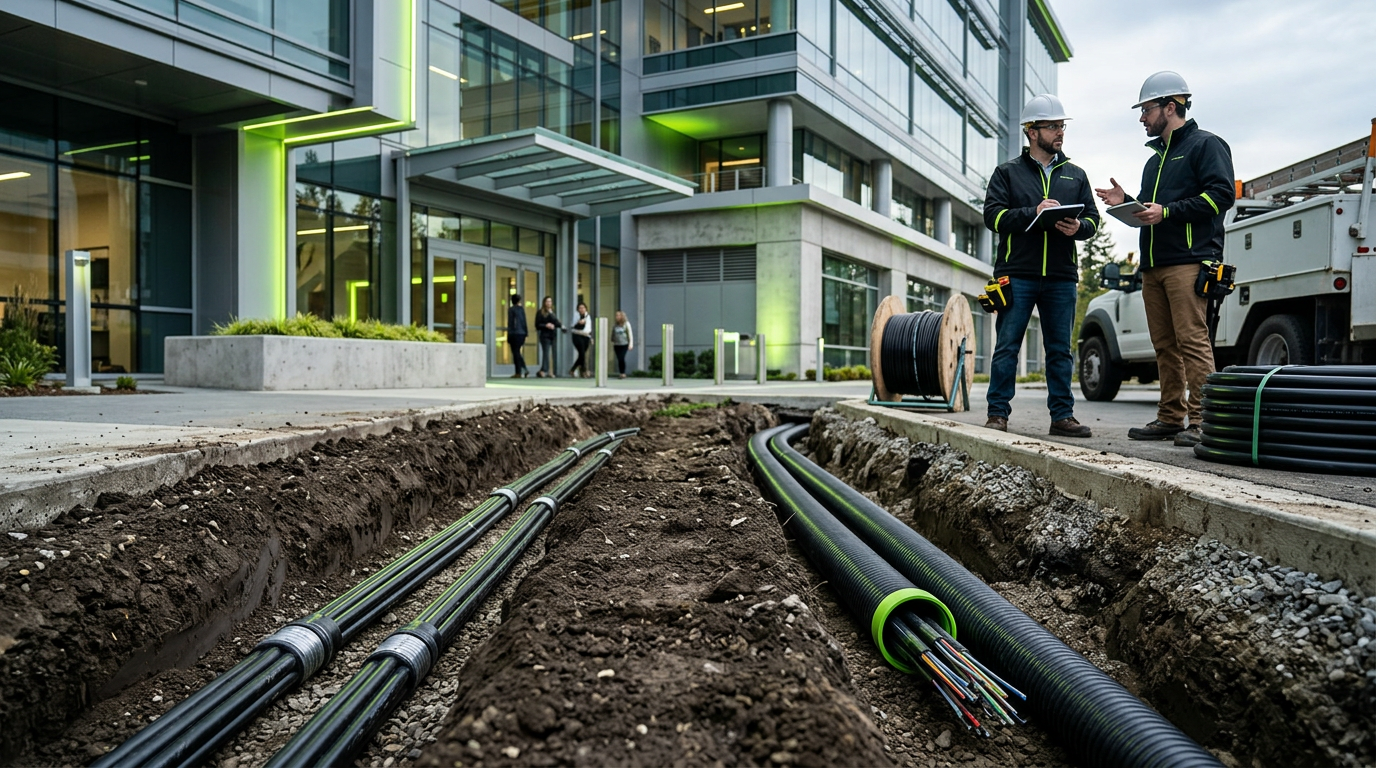
Choosing between direct burial and innerduct depends on your project’s lifespan and budget, but for most Central Florida commercial applications, HDPE innerduct offers a 300% increase in long-term scalability. While direct burial cable reduces upfront material costs by 20-30%, it lacks the physical protection and future-proofing required for high-density fiber or security deployments.
Quick Facts
- HDPE Durability: High-Density Polyethylene (HDPE) conduit can withstand soil pressures exceeding 1,000 PSI.
- Standard Depth: NEC Article 300 requires a minimum cover of 24 inches for direct-buried cables under most commercial conditions.
- Bend Radius: Innerduct allows for a controlled bend radius, typically 10 to 20 times the diameter of the conduit, protecting sensitive fiber glass.
- Service Life: Underground HDPE conduit systems are engineered for a service life of 50+ years, whereas un-protected direct burial jackets may degrade in 15-20 years.
- Scalability: A single 2-inch conduit can house multiple microducts, allowing for future cable pulls without re-trenching.
The Real-World Comparison: A Warehouse Campus Case Study
To understand the impact of this choice, consider a typical 100,000-square-foot warehouse expansion in Tampa. The project required connecting a new security gate and an auxiliary office to the main MDF (Main Distribution Frame).
The Direct Burial Approach (Initial Setup)
In this scenario, the contractor utilized OSP (Outside Plant) rated, armored fiber optic cable. The cable featured a corrugated steel tape armor designed to deflect rodents and minor shovel strikes.
- The Before: The installation was fast. Trenching was shallow (24 inches), and the cable was laid directly into a sand bed. Total material cost was lower because no conduit was purchased.
- The After: Three years later, the facility needed to upgrade from 1G to 10G speeds and add three 4K PTZ security cameras. Because the cable was direct-buried, there was no way to "pull" new lines. The facility had to pay for a second round of trenching, asphalt cutting, and site restoration, effectively doubling the original labor cost.
The Innerduct Approach (Initial Setup)
For a neighboring facility, InCTRL installed a 1.25-inch HDPE smoothwall innerduct system with a detectable pull tape.
- The Before: The upfront cost included the HDPE pipe and specialized couplers. Trenching required slightly more care to ensure the conduit was joined properly to prevent water ingress.
- The After: When this facility decided to add digital signage at the campus entrance two years later, no digging was required. Technicians used the existing pull tape within the innerduct to install two additional Category 6A OSP cables in a single afternoon. The "day two" cost was 75% lower than the direct burial site.
Exterior Pathway Specifications
| Feature | Direct Burial (Armored) | HDPE Innerduct / Conduit |
|---|---|---|
| Upfront Cost | $ (Low) | $$ (Moderate) |
| Installation Speed | High | Moderate |
| Protection Level | Moderate (Rodent/Crush) | High (Crush/Moisture/Shovel) |
| Future-Proofing | Zero (Requires re-trenching) | High (Pull-through capability) |
| Permitting Depth | 24" (Standard) | 18" - 24" (Varies by code) |
The Engineering Logic: Why Innerduct Wins
Direct burial cables, even those with double-armored (DA) jackets, are subject to "ground heave" and shifting soil. In areas with high water tables, the constant immersion can eventually find microscopic fissures in the cable jacket.
HDPE smoothwall conduit acts as a permanent raceway. By using composite HDPE enclosures (like those from Channell or Oldcastle), technicians create accessible points where cables can be spliced or diverted without disturbing the landscape. This is especially critical for projects funded by BEAD (Broadband Equity, Access, and Deployment) or long-term corporate infrastructure where the cost of "truck rolls" and heavy machinery must be minimized over a 10-year cycle.
What This Means in Central Florida
In Central Florida, soil conditions range from soft sand to dense clay, often saturated by a high water table. During the summer hurricane season, soil saturation increases the risk of cable migration and root intrusion. Direct burial cables are more susceptible to damage from lightning strikes traveling through the ground, whereas non-metallic HDPE conduit provides an additional layer of insulation.
Furthermore, Tampa’s rapid development means that landscaping and parking lot renovations are frequent. A direct-buried cable is easily severed by a trencher or even a heavy-duty lawn aerator. A conduit provides a physical warning and a much tougher barrier against accidental strikes. When permitting in Hillsborough or Pinellas County, choosing a conduit system often simplifies the inspection process for structured cabling, as it demonstrates a professional adherence to TIA-758-B (Customer-Owned Outside Plant Telecommunications Infrastructure Standard).
Frequently Asked Questions
Can I mix fiber and copper in the same innerduct?
Yes, you can pull both fiber optic and copper (Category 6 OSP) cables through the same innerduct, provided the total cable fill ratio does not exceed 40% of the conduit’s internal cross-sectional area to prevent heat buildup and tension damage during the pull.
How deep do I need to bury conduit in a parking lot?
Underneath a 4-inch or thicker concrete slab or parking lot, the NEC typically allows for a burial depth of 18 inches. However, we recommend 24 inches in Florida to account for soil erosion and future repaving projects that might involve milling the surface.
What is the purpose of detectable pull tape?
Detectable pull tape contains a small metallic wire. This allows a technician using a utility locator to find the exact path of the underground conduit from the surface, preventing accidental damage during future construction or landscaping projects on your property.
Is smoothwall or corrugated innerduct better?
For long-distance outdoor runs, smoothwall HDPE is preferred because it reduces friction during the cable pulling process. Corrugated innerduct is more flexible and is generally reserved for short, interior "plenum" runs or navigating tight turns within a building's mechanical room.
Does direct burial cable require a specific jacket type?
Yes, direct burial cables must be rated OSP (Outside Plant). These cables typically feature a polyethylene (PE) jacket and are often filled with a water-blocking gel or tape to prevent moisture from traveling through the cable if the jacket is breached.
---
Planning a project like this? See our [structured cabling services](/services/structured-cabling) or [get a free site assessment](/contact) from InCTRL's Orlando team.
Sources
- [HDPE Smoothwall Conduit | Telecom & Broadband Infrastructure](https://teamgalloway.com/products/conduit-fittings/hdpe-smoothwall-conduit)
- [Microduct vs Conduit for FTTH & BEAD Builds - OSP Materials](https://www.ospmaterials.com/microduct-vs-conduit-ftth/)
- [Fiber Connectivity & Passive Components - The Galloway Group](https://teamgalloway.com/products/fiber/fiber-connectivity)
InCTRL Technology Team
Commercial integration specialists with 20+ years installing security, cabling, signage, AV and IT systems across Central Florida. About us
Explore our services
Areas we serve
Need This Done at Your Facility?
Orlando-based since 2004 — 3,300+ jobs completed. Talk to a real technician, not a call center.