Biometrics in Healthcare: Merging Surveillance with Touchless Entry
Discover how healthcare facilities are integrating AI-driven cameras with touchless access to enhance security and hygiene mid-2026.
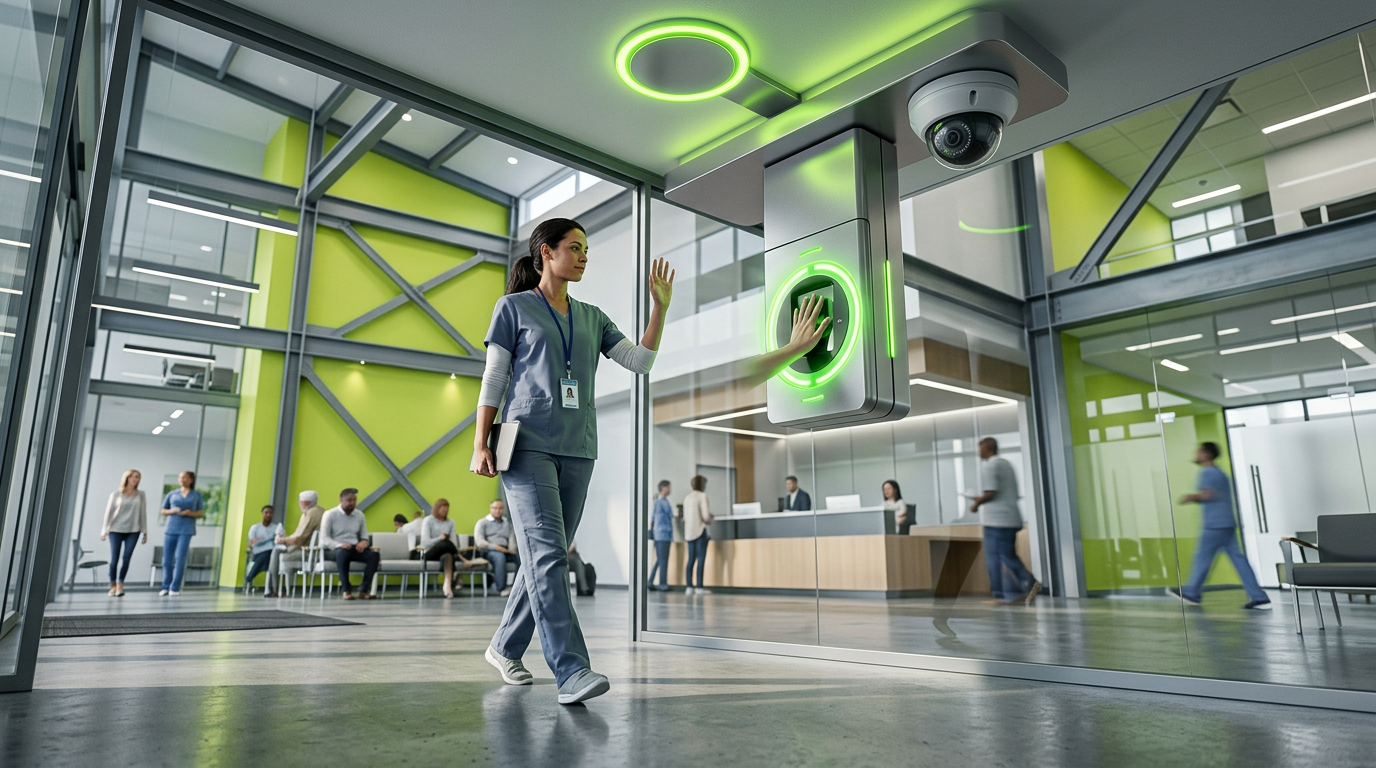
In a high-traffic surgical wing, every second spent fumbling for a badge or touching a keypad represents more than just a bottleneck—it’s a potential lapse in sterile protocol and a delay in patient care.
As we move through 2026, the global video surveillance market is projected to reach $28 billion, driven largely by a surge in AI-integrated hardware. For healthcare administrators, this technological shift is moving beyond simple monitoring. We are seeing a convergence where high-definition surveillance cameras, powered by advanced AI models like the recently debuted Aurora Flow, are becoming the primary sensors for touchless access control.
The Traditional Model: The Friction Case Study
Until recently, most healthcare facilities relied on a fragmented security ecosystem. To understand the impact of the new biometric shift, let’s look at the standard operating procedure that many hospitals are currently moving away from.
The "Before" Scenario:
- Hardware: Legacy 1080p cameras and proximity card readers.
- Process: An ICU nurse carrying supplies must set them down, locate a physical badge, and swipe or tap to enter a restricted zone.
- Security Gaps: "Tailgating" (unauthorized people following a staff member through a door) is difficult to track in real-time. Lost or shared badges create significant compliance risks under HIPAA and other health safety regulations.
- Maintenance: Physical wear on card readers and the constant cost of reissuing plastic credentials.
In this model, the security camera is a passive observer, used only for forensic review after an incident has occurred.
The Future Model: Integrated Biometric Intelligence
Healthcare facilities are now adopting unified systems where the camera is the credential. By leveraging dual-lens technology—similar to the panoramic capabilities seen in the latest 4K outdoor systems—and AI-driven facial recognition, the entry process becomes invisible.
The "After" Scenario:
- Hardware: 4K AI-enabled cameras with dual-lens pan/tilt functionality and integrated electronic strikes.
- Process: As a surgeon approaches the scrub room, the overhead camera identifies the individual in milliseconds using encrypted biometric signatures. The door unlocks automatically. No contact, no stopping, no physical badge required.
- Security Gains: The system uses "Liveness Detection" to ensure the person is real (preventing photo-spoofing) and immediately alerts security if an unrecognized individual attempts to follow a staff member through the door.
- Operational Efficiency: Real-time metadata allows administrators to track flow patterns, optimizing staffing levels during peak hours based on actual movement data.
Measurable Outcomes of Touchless Integration
When we transition a facility from legacy badge-access to integrated biometric entry, the results aren't just theoretical; they are quantifiable. Recent industry implementations have shown significant shifts in three key areas:
1. Infection Control
By eliminating the need to touch high-contact surfaces like keypads or handles, facilities see a measurable reduction in cross-contamination risks. In a clinical environment, reducing physical touchpoints is a fundamental pillar of modern hygiene strategy.
2. Throughput and Efficiency
Traditional badge swipes take an average of 3–5 seconds per encounter. In a facility where a nurse enters restricted zones 40 times a day, biometric entry can reclaim nearly 15 minutes of productive time per shift, per staff member. For a large hospital, this scales to hundreds of hours of reclaimed clinical time every month.
3. Forensic Accuracy
Legacy systems often show *that* a badge was used, but not *who* used it. Integrating AI surveillance with access control ensures that the log entry and the video footage are one and the same. This provides a 100% verifiable audit trail for pharmacy hubs and sensitive patient records.
The Role of Structured Cabling and AV
This level of integration requires more than just buying a smart camera. The surge in AI-driven security costs is largely due to the need for robust backend infrastructure.
- Fiber Optic Backbones: To handle the bandwidth of multiple 4K streams with zero latency for real-time unlocking.
- Category 6A Cabling: Essential for Power over Ethernet (PoE++) to support high-performance AI cameras that require more juice than standard models.
- Digital Signage Integration: Using the same network to provide real-time status updates (e.g., "Room Occupied" or "Access Denied") to staff via wall-mounted displays.
Strategic Implementation
For Central Florida healthcare providers looking to upgrade, the path forward involves a phased approach. It begins with identifying high-security "choke points"—such as pharmacies, maternity wards, and IT server rooms—where biometric touchless entry provides the highest immediate ROI.
As the technology matures, these systems are becoming more accessible. With the entry of major tech players into the professional-grade AI space, the software is becoming more intuitive, allowing security teams to manage thousands of access points from a single, unified dashboard.
At InCTRL Technology Services, we focus on the intersection of these technologies, ensuring that your structured cabling can support the heavy data demands of the next generation of biometric security.
Sources
- [Video Surveillance](https://www.securityinfowatch.com/video-surveillance)
- [Smart Home Security Camera Market Size to Surpass USD ...](https://www.precedenceresearch.com/smart-home-security-camera-market)
- [Best Home Security Cameras of 2026](https://www.security.org/security-cameras/best/)
InCTRL Technology Team
Commercial integration specialists with 20+ years installing security, cabling, signage, AV and IT systems across Central Florida. About us
Explore our services
Areas we serve
Need This Done at Your Facility?
Orlando-based since 2004 — 3,300+ jobs completed. Talk to a real technician, not a call center.